
Speakinfinite

Author name: speakinfinite.si

CELPIP Preparation Course in Saskatoon: Why Local Coaching Matters
CELPIP

CELPIP Preparation Course in Saskatoon: Why Local Coaching Matters

Moving to Canada, building a career in Saskatchewan, or finalizing your permanent residency application requires hitting your target language scores. For thousands of candidates across the province, the Canadian English Language Proficiency Index Program (CELPIP) is the exam of choice. Fully computer-delivered and aligned with daily Canadian life, the CELPIP test evaluates your abilities across four modules: Listening, Reading, Writing, and Speaking. However, scoring a Canadian Language Benchmark (CLB) 7, 8, or 9 is rarely a matter of luck. Many candidates who speak fluent conversational English find themselves stuck at a CLB 6 or 7 due to strict timing constraints, specific scoring criteria, or test anxiety. If you are living in the Bridge City, enrolling in a structured CELPIP preparation course in Saskatoon can make all the difference between rebooking your exam multiple times and clearing your target score on the very first try. Here is why local coaching matters and how selecting the right training program will set you up for success. The Reality of Taking the CELPIP in Saskatchewan Saskatchewan has become one of Canada’s most dynamic regional destinations for international skilled workers, healthcare professionals, tradespeople, and international graduates. Whether you are applying through the Saskatchewan Immigrant Nominee Program (SINP), federal Express Entry, or Canadian citizenship pathways, your CELPIP score directly impacts your ranking points. ┌──────────────────────────────┐ │ PR / Citizenship Pathway │ └──────────────┬───────────────┘ │ ┌─────────────────────────┴─────────────────────────┐ ▼ ▼ ┌─────────────────────────────────┐ ┌─────────────────────────────────┐ │ Saskatchewan Immigrant │ │ Federal Express Entry │ │ Nominee Program (SINP) │ │ & Citizenship Stream │ └────────────────┬────────────────┘ └────────────────┬────────────────┘ │ │ ▼ ▼ ┌─────────────────────────────────┐ ┌─────────────────────────────────┐ │ CLB 4 – 7+ Required Depending │ │ CLB 7 – 9+ Target Range for │ │ on Occupation Stream │ │ Maximum CRS Points Boost │ └─────────────────────────────────┘ └─────────────────────────────────┘ The test relies entirely on Canadian accents, regional vocabulary, and everyday scenarios—such as replying to a landlord’s email, expressing an opinion at a community meeting, or understanding a workplace discussion. While the test format seems approachable, the computer-based interface enforces rigid timers. For instance, the Speaking module gives you as little as 30 seconds to prepare a response and 60 to 90 seconds to deliver it. Without specialized strategies, even strong English speakers panic under the ticking clock. Why Local Coaching Trumps Generic Self-Study While online practice sets and video tutorials are helpful, they lack the individualized feedback required to fix subtle language patterns. Investing in a dedicated CELPIP preparation course in Saskatoon provides clear advantages that online self-study simply cannot replicate. 1. Direct Knowledge of Local Saskatoon Test Centers Saskatoon hosts several official testing venues: Saskatchewan Polytechnic (Idylwyld Drive North) International Women of Saskatoon (IWS) (5th Avenue North) BITTS Testing Services (Avenue C North) Local coaches know these environments inside out. They can prepare you for room acoustics, background noise from other test-takers during the speaking component, and headphone setups. Practicing under conditions that match local test centers eliminates unexpected surprises on exam day. 2. Personalized Feedback on Speaking and Writing The CELPIP Speaking and Writing sections are evaluated by human raters using strict performance descriptors (Coherence, Vocabulary, Task Fulfillment, and Readability). When you study alone, you have no way of knowing whether your speaking cadence is too fast, your sentence structures are repetitive, or your writing lacks clear transitional phrases. A local coach evaluates your recorded responses in real time, pinpointing errors in grammar, tone, and organization before they impact your actual score. ┌──────────────────────────────────────────────┐ │ Interactive CELPIP Preparation Framework │ └──────────────────────┬───────────────────────┘ │ ┌────────────────────────────┼────────────────────────────┐ ▼ ▼ ▼ ┌──────────────────┐ ┌──────────────────┐ ┌──────────────────┐ │ Diagnostic Exam │ │ Skill-Building │ │ Full Simulation │ │ & Weakness Map │───────►│ & Content Prep │───────►│ & Timed Mocks │ └──────────────────┘ └──────────────────┘ └──────────────────┘ 3. Tailored Alignment with SINP and Immigration Goals Saskatoon-based instructors work daily with students navigating the local immigration ecosystem. They understand how different SINP streams weigh your language benchmark scores and can tailor your training intensity to meet your specific deadlines. 4. Classroom Accountability and Peer Practice Studying in a local classroom or interactive small-group setting forces you to step outside your comfort zone. Speaking into a microphone in front of peers simulates the ambient chatter of an actual test room, building your psychological resilience and concentration. Key Features to Look for in a Preparation Program Not all coaching centers deliver equal results. When evaluating a CELPIP preparation course in Saskatoon, ensure the curriculum includes these four core pillars: Course Feature What You Should Look For Why It Matters Official Mock Tests Software mimicking the real Paragon CELPIP test interface Prevents technical confusion with button navigation or timers on test day Task-Specific Templates Frameworks for Writing Task 1 (Email) & Task 2 (Survey Response) Ensures proper formatting, correct tone, and complete task coverage Timed Speaking Drills Audio recording software with countdown timers Builds natural pacing without stopping mid-sentence when time expires Small Class Sizes Ratio of 1:8 or smaller, or 1-on-1 private instruction Guarantees individual attention for error correction and accent clarity Pro Tip: Ask prospective coaching providers if their practice materials reflect recent CELPIP question updates. Training with outdated materials can lead to practicing the wrong essay formats or speaking prompts. Breaking Down the 4 Modules: Master Classroom Strategies A quality CELPIP preparation course in Saskatoon equips you with proven strategies tailored to each part of the test: Speaking (8 Tasks) The Challenge: Speaking into a computer microphone while other candidates in the room are talking simultaneously. The Strategy: Learn structured response templates. For instance, in Task 3 (Describing a Scene), local instructors train you to use spatial prepositions (“In the foreground,” “Adjacent to the building”) while maintaining steady oral fluency without fillers like “um” or “uh.” Task 1: Applying Advice ──► Focus on empathetic, structured guidance Task 3: Describing a Scene ──► Use spatial prepositions & vivid details Task 5: Comparing & Persuading ──► Highlight benefits while respecting budget Task 7: Expressing Opinions ──► State clear position with 2 supporting points Writing (2 Tasks) The Challenge: Crafting an effective email (Task 1) and responding to an opinion survey (Task 2) within


PTE Core Coaching in Calgary: What to Look for in a Training Program
PTE

PTE Core Coaching in Calgary: What to Look for in a Training Program

Securing permanent residency, a work permit, or citizenship in Canada requires proving your English proficiency. For years, applicants relied almost exclusively on exams like IELTS General or CELPIP. However, the introduction of the PTE Core (Pearson Test of English Core)—officially recognized by Immigration, Refugees and Citizenship Canada (IRCC)—has transformed the landscape. With its rapid, AI-driven scoring (often delivered within 48 hours) and a modular, computer-based format, thousands of candidates are flocking to take this test. If you are living in Alberta’s economic hub, enrolling in a dedicated pte coaching calgary program is one of the smartest investments you can make to reach your target Canadian Language Benchmark (CLB) score. However, not all preparation centers are created equal. Searching for a high-quality pte course canada options can leave you feeling overwhelmed by marketing promises. How do you separate top-tier instruction from generic test mills? This guide breaks down everything you need to know about choosing the best PTE Core preparation in Calgary, understanding the test structure, and setting yourself up for success on exam day. What Is PTE Core and Why Does It Matter for Canadian Immigration? Before diving into training programs, it is essential to understand what makes PTE Core unique. Unlike the PTE Academic test (which is designed for university admissions), PTE Core focuses on everyday, vocational English. It evaluates real-world communication across four core areas: Speaking, Writing, Reading, and Listening. Why Applicants Prefer PTE Core: Fully Computerized & AI-Scored: No human examiners mean unbiased, objective scoring across speech recognition and written tasks. Fast Turnaround: You typically receive your results in just 2 days. Single 2-Hour Session: Unlike tests split across multiple days or lengthy sittings, PTE Core is streamlined into one 2-hour sitting. Direct Alignment with CLB: Pearson maps PTE Core scores straight to CLB levels (such as CLB 7, 8, or 9), which are crucial for Express Entry, Provincial Nominee Programs (PNPs) like the Alberta Advantage Immigration Program (AAIP), and citizenship applications. To hit these high CLB targets, simply knowing English isn’t enough; you must understand the algorithm, time constraints, and scoring mechanics. This is where specialized pte coaching calgary institutes become invaluable. Key Features to Look for in a Calgary PTE Training Program When evaluating local academies or hybrid online platforms in Calgary, keep an eye out for these essential criteria: ┌──────────────────────────┐ │ PTE Core Academy Check │ └─────────────┬────────────┘ │ ┌──────────────────┬───────────┴───────────┬──────────────────┐ ▼ ▼ ▼ ▼ ┌──────────────────┐┌───────────────┐ ┌──────────────────┐┌──────────────────┐ │ Official AI ││ Experienced │ │ Comprehensive ││ Flexible Class │ │ Diagnostic Tools ││ Instructors │ │ Strategy Modules ││ Scheduling │ └──────────────────┘└───────────────┘ └──────────────────┘└──────────────────┘ 1. Pearson-Aligned AI Scoring Tools PTE Core is scored entirely by computer algorithms. Therefore, practicing with pencil and paper or taking unstandardized quizzes will not prepare you for test day. A premier pte course canada provider should give you access to AI-powered mock platforms that replicate Pearson’s actual scoring engine. Look for programs offering detailed score reports that break down your pronunciation, oral fluency, vocabulary range, and grammar. 2. Instructors Experienced with the Canadian Context While PTE is a global test, your goals are uniquely Canadian. Top-tier institutes providing pte coaching calgary employ trainers who understand IRCC requirements inside and out. They can translate your target CLB requirements into specific PTE point totals, helping you focus your energy where it matters most. 3. Coverage of Specific PTE Core Question Types PTE Core features distinct tasks that differ from other PTE formats—such as Summarize Written Text, Write Email (which replaced the academic essay requirement), and Respond to a Situation in the speaking section. Ensure your chosen institute offers targeted strategies for these practical, scenario-based questions. 4. Small Class Sizes and Customized Feedback Generic lectures rarely address individual flaws like speech pauses, mic handling errors, or minor grammar habits. The best pte coaching calgary centers keep class sizes small or offer 1-on-1 coaching sessions to provide direct feedback on your speech delivery and writing templates. 5. Flexible Class Schedules Many candidates seeking PR in Calgary are balancing full-time jobs, family commitments, or studies. Look for training centers that offer evening classes, weekend workshops, or self-paced hybrid access so you can study without disrupting your daily routine. Comparing Preparation Formats: In-Person vs. Online Calgary test-takers can choose between local classroom instruction and interactive online training. Both options offer clear benefits: Feature In-Person Classes (Calgary Centers) Online PTE Courses (Canada-Wide) Learning Environment Physical classroom, structured schedule At-home, flexible hours Hardware Access Desktop setups mimicking actual test centers Requires your own PC, headset, and stable internet Interaction Immediate face-to-face feedback from tutors Live chat, video calls, and automated AI portal reviews Best For Learners who thrive on accountability and direct structure Busy professionals needing late-night or weekend flexibility Pro Tip for Calgary Test-Takers: Even if you choose an online pte course canada option, practice in an environment that mimics the real exam. PTE test centers can be slightly noisy as multiple candidates speak simultaneously. Practicing with ambient background noise using a dedicated headset will help build your confidence. Essential Section-by-Section Prep Strategies A comprehensive training program will equip you with specific tactical approaches for every part of the test: Speaking & Writing Oral Fluency First: The AI algorithm prioritizes smooth, unhesitating speech over an overly complex accent. A quality trainer will teach you to maintain a steady rhythm without long pauses. Master Email Formats: In PTE Core, the writing task often involves drafting a business or personal email. Learn structured approaches for formal, semi-formal, and informal tone requirements, paying close attention to word counts. Reading & Listening Time Management: The Reading section moves quickly. Techniques like skimming for main ideas and recognizing transitional keywords can save crucial seconds. Active Listening Note-Taking: Tasks like Summarize Spoken Text require capturing key facts on the fly. Elite pte coaching calgary courses teach shorthand note-taking strategies so you don’t miss essential details while listening. Recommended Step-by-Step Study Timeline Week 1: Initial Assessment & Diagnostics ├── Take an official scored diagnostic mock test └── Identify specific weaknesses (e.g., Fluency vs. Grammar) Weeks

PTE Core Course in Canada: Prep Guide for Express Entry
Blog

PTE Core Course in Canada: Prep Guide for Express Entry

Proving your English proficiency is one of the most effective ways to maximize your Comprehensive Ranking System (CRS) points for Express Entry. While applicants traditionally chose IELTS General or CELPIP, Immigration, Refugees and Citizenship Canada (IRCC) officially accepts the PTE Core (Pearson Test of English Core) for economic class immigration pathways. Featuring 100% computer-based administration, rapid AI-driven results delivered within 2 to 5 business days, and a streamlined 2-hour testing session, thousands of candidates are enrolling in a dedicated pte course canada to hit their target Canadian Language Benchmark (CLB) scores. However, achieving high scores in a computer-evaluated exam requires specialized preparation. Success is not just about general English skills; it requires understanding the speech recognition algorithms, time constraints, and scoring nuances of the test. This prep guide explores what to look for in a pte core preparation strategy, how PTE Core scores map to CLB levels, and how to structure your study plan for maximum CRS points. Why PTE Core Has Become a Preferred Exam for Express Entry PTE Core measures practical, vocational English skills across four distinct modules: Speaking, Writing, Reading, and Listening. Unlike academic tests, PTE Core focuses on everyday communication scenarios—such as reading workplace notices, drafting emails, or responding to situational prompts. ┌─────────────────────────────────────────┐ │ PTE Core Advantage for Canada PR │ └────────────────────┬────────────────────┘ │ ┌────────────────────────────────┼────────────────────────────────┐ ▼ ▼ ▼ ┌─────────────────┐ ┌──────────────────┐ ┌─────────────────┐ │ Objective AI │ │ Streamlined Test │ │ Rapid Results │ │ Scoring │ │ Format │ │ Turnaround │ └────────┬────────┘ └────────┬─────────┘ └────────┬────────┘ │ │ │ ▼ ▼ ▼ Fully automated scoring Single 2-hour session Scores typically eliminates human bias combines all 4 modules delivered in 2 to for speaking/writing at a computer station 5 business days Key Highlights for Immigration Candidates: Targeted Tasks: Instead of long academic essays, PTE Core assesses writing through tasks like Write Email and Summarize Written Text. Fast Score Turnaround: Fast score reports allow you to submit or update your Express Entry profile without long waiting periods. Single Test Session: All four modules are completed in one 2-hour sitting at an official test center. Understanding PTE Core Scores & Express Entry CRS Points To succeed in Express Entry, you must aim beyond minimum eligibility. IRCC evaluates language test scores using Canadian Language Benchmark (CLB) levels. Understanding how your raw PTE Core scores map to CLB thresholds is critical for setting your target scores. ┌──────────────────────────────────────┐ │ Express Entry Language Strategy │ └──────────────────┬───────────────────┘ │ ┌───────────────────────────────┴───────────────────────────────┐ ▼ ▼ ┌──────────────────────────────────────┐ ┌──────────────────────────────────────┐ │ CLB 7: Minimum Threshold │ │ CLB 9: The Target Benchmark │ └──────────────────┬───────────────────┘ └──────────────────┬───────────────────┘ │ │ ▼ ▼ Qualifies for Express Entry pool, Unlocks significant CRS score gains but offers lower core points and skill transferability points Official PTE Core to CLB Conversion Table (2026 Reference) CLB Level Listening Reading Writing Speaking Express Entry Impact CLB 10 89+ 88+ 90 89+ Maximum possible language points CLB 9 82–88 78–87 88–89 84–88 Primary Target: Unlocks major CRS boost CLB 8 71–81 69–77 79–87 76–83 Solid score; adds competitive points CLB 7 60–70 60–68 69–78 68–75 Minimum eligibility for Federal Skilled Worker Crucial Rule: Your effective CLB level for Express Entry is determined by your lowest individual module score, not an average. A well-rounded pte core preparation program ensures balanced skill development across all four components. What to Look for in a PTE Core Preparation Course With many language schools offering training, selecting an effective pte course canada program requires evaluating several critical components: ┌────────────────────────────────────────┐ │ PTE Course Selection Essentials │ └───────────────────┬────────────────────┘ │ ┌───────────────────┬───────────┴───────────┬───────────────────┐ ▼ ▼ ▼ ▼ ┌──────────────────┐┌──────────────────┐ ┌──────────────────┐┌──────────────────┐ │ AI Mock Platforms││ Task-Specific │ │ Acoustic Prep ││ Individualized │ │ with Diagnostics ││ Templates │ │ Coaching ││ Score Feedback │ └──────────────────┘└──────────────────┘ └──────────────────┘└──────────────────┘ 1. Accurate AI Diagnostic Tools Because Pearson uses automated software to evaluate speaking fluency, pronunciation, and writing mechanics, your practice tests should match this scoring environment. Premium coaching providers use AI mock test engines that provide detailed diagnostic feedback on oral fluency, rhythm, and structural accuracy. 2. Expert Strategy Training for Core Tasks Generic language courses often focus on grammar worksheets rather than exam-specific techniques. A focused pte course canada curriculum teaches exact strategies for unique PTE tasks, including: Respond to a Situation: Formatting spoken responses under 40-second time limits. Write Email: Maintaining appropriate tone, structure, and word count (100–150 words) within 9 minutes. Read Aloud: Managing natural stress, intonation, and phrasing without unnatural pauses. 3. Noise Management and Microphone Familiarity PTE test centers accommodate multiple test-takers simultaneously, meaning you will speak into your microphone while others are doing the same. Structured pte core preparation includes training in noisy environments to help you build focus and maintain steady vocal delivery on exam day. Section-by-Section Exam Strategies ┌─────────────────────────────────────────────────────────────┐ │ PTE Core Section Strategy Matrix │ └──────────────────────────────┬──────────────────────────────┘ │ ┌──────────────────────────────┼──────────────────────────────┐ ▼ ▼ ▼ ┌─────────────────┐ ┌─────────────────┐ ┌─────────────────┐ │ Speaking │ │ Writing │ │ Reading │ │ & Writing │ │ Skills │ │ & Listening │ └────────┬────────┘ └────────┬────────┘ └────────┬────────┘ │ │ │ ▼ ▼ ▼ Focus on oral fluency; Use clear email Practice time management; avoid false starts and structures; maintain master shorthand note- unnecessary pauses word count rules taking for audio tasks Speaking & Writing (50–65 Minutes) Maintain Oral Fluency: The AI algorithm heavily weights speech continuity. Avoid self-correcting or pausing mid-sentence. If you make a minor mistake, keep going smoothly. Structure Your Written Email: In the Write Email task, open with a clear purpose statement, include 2–3 supporting points, and close with an appropriate sign-off. Reading (27–37 Minutes) Master Re-Order Paragraphs: Look for standalone topic sentences containing explicit subject nouns, then trace pronoun references and transitional connectors. Manage Total Time: Unlike the writing section where each task has its own clock, the Reading module uses a single overall timer. Avoid spending more than 1.5 to 2 minutes on any single multiple-choice question. Listening (22–37 Minutes) Write From Dictation Focus: This task carries high weight for both listening and writing scores. Listen carefully to the sequence of words, write notes immediately, and verify your spelling before submitting. Shorthand Note-Taking:

CELPIP Prep Course in Saskatoon | Success Stories & PR Coaching
CELPIP

CELPIP Prep Course in Saskatoon / Success Stories

For candidates navigating permanent residency pathways, skilled worker nominations, or citizenship applications in Saskatchewan, language proficiency stands as one of the most decisive milestones. The Canadian English Language Proficiency Index Program (CELPIP) evaluates your real-world ability to communicate in everyday Canadian contexts—ranging from responding to workplace emails to interpreting local news broadcasts and participating in community discussions. Achieving a Canadian Language Benchmark (CLB) level of 9 or higher opens doors across federal and provincial streams, notably through the Saskatchewan Immigrant Nominee Program (SINP). However, reaching your target score requires strategic preparation tailored specifically to the computer-delivered format of the test. Enrolling in a targeted celpip preparation course provides test takers with the structured guidance, timing strategies, and localized feedback necessary to transform potential score bottlenecks into top-tier results. Why Localized Training Matters in Saskatoon Preparing for the CELPIP exam in Saskatchewan presents distinct advantages when using a curriculum calibrated to local test environments and expectations. Local candidates often sit for their examinations at recognized venues across the city, such as the Saskatchewan Polytechnic test center located at 1130 Idylwyld Drive North or testing facilities near 2365 Ave C North and 5th Avenue North. Enrolling in a celpip course saskatoon canada connects candidates with instructors who understand the exact hurdles test takers face in the province. From mastering the speed-typing requirements on Canadian keyboard layouts to managing background room noise during the simultaneous Speaking module, specialized instruction turns unfamiliarity into confidence. ┌─────────────────────────────────────────────────────────┐ │ Key Pillars of Strategic CELPIP Preparation │ └────────────────────────────┬────────────────────────────┘ │ ┌──────────────────────────┼──────────────────────────┐ ▼ ▼ ▼ ┌─────────────────┐ ┌─────────────────┐ ┌─────────────────┐ │ Dynamic Timing │ │ Native Canadian │ │ Automated & │ │ & Pace Control │ │ Phrasal Usage │ │ Live Evaluation │ └─────────────────┘ └─────────────────┘ └─────────────────┘ Deconstructing the Four CELPIP Modules A comprehensive celpip preparation course addresses each test component systematically, targeting both technical skill and time management. 1. Listening Module The Listening test features Canadian accents, natural cadence, and everyday scenarios. The Challenge: Conversations run once without repeating. Visual cues on the screen (such as video passages) require divided attention. The Strategy: Learn to take shorthand notes capturing keywords, emotional tone, and core decisions rather than attempting word-for-word transcriptions. Practice distinguishing subtle shifts in opinion during multi-speaker dialogues. 2. Reading Module Reading passages scale in difficulty from simple informal notes to complex, opinionated editorial pieces. The Challenge: Locating specific details under tight countdown timers without getting bogged down by unfamiliar vocabulary. The Strategy: Utilize skimming techniques to grasp the main purpose before reading questions, followed by scanning to isolate matching key phrases. Targeted preparation teaches candidates how to handle distractor options engineered to look correct at first glance. 3. Writing Module The Writing component consists of two tasks: writing an email and responding to a survey question. The Challenge: Adhering strictly to word count ranges (150–200 words) while showcasing advanced sentence structures, proper tone (formal vs. informal), and coherent transitional phrases. The Strategy: Master reusable structural frameworks for task completion. A dedicated celpip course saskatoon canada guides candidates in building varied vocabulary decks suitable for workplace, municipal, and social scenarios. 4. Speaking Module With eight distinct prompts, the Speaking section moves rapidly from advice-giving to expressing personal opinions and describing complex scenes. The Challenge: On-screen timers demand immediate organization of thoughts within 30 to 60 seconds of preparation time. The Strategy: Practice structured response templates that eliminate pauses, hesitation, and repetitive fillers (“um”, “ah”). Instructors provide precise feedback on intonation, pace, and clarity to ensure maximum marks under the “Deliverability” criterion. Real Success Stories: From Saskatoon Classrooms to Target Scores The impact of formal preparation is best seen through the experiences of local candidates who transformed their score trajectories through dedicated study. Story 1: Navigating the Jump from CLB 7 to CLB 10 Candidate: Hardeep S., Software Developer Target: Needed CLB 9 across all modules for Express Entry Express Stream eligibility. Initial Result: L: 8 | R: 8 | W: 7 | S: 6 Hardeep had attempted the test twice independently at the 1130 Idylwyld Drive North test venue. Despite strong English comprehension skills, his speaking score remained stalled at CLB 6 due to continuous self-correction and timer anxiety. “I thought my everyday conversational English was enough, but CELPIP Speaking is an artificial environment. You are talking to a computer screen in a room full of other test takers. Joining a specialized celpip preparation course taught me how to structure my 60-second responses using clear topic sentences and transitions. Within four weeks, I raised my Speaking score to CLB 10.” Key Takeaway: Structured template practice and simulated environment drills eliminate hesitation during high-pressure timed responses. Story 2: Mastering the Writing Format for Permanent Residency Candidate: Elena M., Healthcare Support Specialist Target: Required CLB 8+ for the SINP Healthcare Professional Category. Initial Result: L: 9 | R: 9 | W: 6 | S: 8 Elena consistently scored high in receptive modules (Listening and Reading) but struggled with the CELPIP survey response in Writing Task 2. Her essay style was overly academic, causing her to run out of time during editing. By enrolling in a targeted celpip course saskatoon canada, Elena received direct, line-by-line feedback from certified instructors. She learned how to adopt the balanced tone required for Canadian community surveys, proper paragraph structure, and key connector phrases that signpost arguments cleanly. Elena’s Final Scores: Module Initial Score Score After Course Listening 9 10 Reading 9 10 Writing 6 9 Speaking 8 9 Story 3: Overcoming Time Constraints as a Working Professional Candidate: Amritpal K., Logistics Supervisor Target: CLB 7 for Canadian Citizenship application. Challenge: Balancing full-time work shifts while preparing for the exam. Amritpal needed a course option near central transportation corridors, making access near 2365 Ave C North or flexible evening hybrid classes essential. Through micro-learning modules focused on high-yield test mechanics—such as recognizing passage organization in Reading Task 3—he achieved his goal in three weeks. “Having an instructor correct my specific grammar patterns and tone errors saved me months of trial and error. The targeted homework assignments

CELPIP Prep Course in Saskatoon | Success Stories & PR Coaching
CELPIP

CELPIP Coaching in Toronto: Comprehensive Guide to Achieving CLB 9+

For professionals and skilled workers applying for Canadian Permanent Residency (PR) or citizenship, passing the Canadian English Language Proficiency Index Program (CELPIP) is a critical milestone. A high Canadian Language Benchmark (CLB) score significantly impacts your Express Entry Comprehensive Ranking System (CRS) score or Ontario Immigrant Nominee Program (OINP) points. Whether you plan to sit for your exam at major test centers along Yonge Street, Bloor Street West, Spadina Avenue, or University Avenue, enrolling in dedicated CELPIP Coaching in Toronto equips you with the strategies, timing discipline, and targeted feedback needed to reach CLB 9, 10, or higher. Why Choose Dedicated CELPIP Coaching in Toronto? Toronto is Canada’s primary hub for newcomers, business professionals, and international graduates. While the GTA offers various general ESL courses, specialized CELPIP Coaching in Toronto focuses specifically on the computer-delivered format of the CELPIP-General and CELPIP-General LS exams. ┌──────────────────────────────────────────────────────────────┐ │ Core Pillars of Professional CELPIP Preparation │ └──────────────────────────────┬───────────────────────────────┘ │ ┌────────────────────────────┼────────────────────────────┐ ▼ ▼ ▼ ┌───────────────────┐ ┌───────────────────┐ ┌───────────────────┐ │ Computer-Delivered│ │ Real-Time Diagnostic│ │ Strategic Accent │ │ Exam Strategy │ │ Evaluation │ │ & Tone Modules │ └───────────────────┘ └───────────────────┘ └───────────────────┘ When you prepare with an established CELPIP course in Toronto, you benefit from: Test-Center Familiarity: Familiarity with the exact hardware setups, Canadian keyboard layouts, and acoustic environments used at prominent test sites—such as 180 Bloor Street West, 455 Spadina Avenue, or 443 University Avenue. Targeted Scoring Mechanics: Understanding how Paragon Testing Enterprises (and Prometric) evaluate your responses under the four criteria: Coherence/Meaning, Lexical Range, Readability, and Task Completion. Structured Timers: Learning to manage strict countdown clocks during the Speaking and Writing sections without freezing or under-delivering. Breakdown of the Four CELPIP Test Modules A comprehensive CELPIP course in Toronto breaks down each module into actionable techniques tailored to real-world Canadian contexts. 1. Listening Section (47–55 Minutes) The listening module features audio clips using standard Canadian accents and colloquial expressions. Passage Types: Listening to Problem Solving, Daily Conversations, Information, News Items, Discussion, and Viewpoints. Key Challenges: Passages are played once only. Audio tracks in the Viewpoints section often feature multiple speakers with differing perspectives. Strategic Solution: Learn shorthand note-taking techniques that track speaker arguments, transitional shifts, and core conclusions without missing ongoing audio cues. 2. Reading Section (55–60 Minutes) The reading section evaluates your ability to digest everyday communications, official notices, diagrams, and opinionated editorials. Passage Types: Reading Correspondence, Diagrams, Information, and Viewpoints. Key Challenges: Distractor choices designed to trip up test takers who search for keyword matches rather than contextual meaning. Strategic Solution: Master skimming for structural framework and scanning for specific evidence, avoiding time traps on complex vocabulary. 3. Writing Section (53–60 Minutes) The writing component requires two distinct responses ranging between 150 to 200 words. Task 1: Writing an Email (Informal, Semi-Formal, or Formal). Task 2: Responding to a Corporate or Community Survey. Key Challenges: Maintaining the appropriate register and tone while using advanced connectors and varied sentence structures under tight deadlines. Strategic Solution: Deploy proven structural templates for opening lines, body arguments, and professional sign-offs. 4. Speaking Section (15–20 Minutes) The speaking module presents eight distinct prompts delivered entirely into a microphone connected to a computer terminal. Task Types: Advising, Personal Experiences, Describing Scenes, Predicting Outcomes, Handling Difficult Situations, Expressing Opinions, and Analyzing Visuals. Key Challenges: Managing preparation times (30–60 seconds) and speaking timers (60–90 seconds) while sitting in a room alongside other test takers speaking simultaneously. Strategic Solution: Practice in simulated testing environments to build focus, master smooth delivery templates, and eliminate hesitation markers (“um”, “like”, “ah”). Test Centers Across Toronto & the Greater Area Understanding where you will sit for your celpip test toronot allows you to simulate test-day conditions effectively. Toronto hosts multiple official test centers located near transit hubs: Location / Street Name Area / Landmark Test Center Context Bloor Street West Downtown Toronto (Yonge & Bloor) Prometric Testing Facilities Spadina Avenue Downtown / University District BITTS & English Testing Canada University Avenue Downtown Financial Centre ILSC Toronto Testing Site Yonge Street Midtown / North York Precise Solutions & Partner Locations Eglinton Avenue West Midtown Corridor Professional Testing Offices Tip: Taking mock exams using full-sized keyboards and headsets helps replicate the exact room conditions at sites along Spadina Avenue or Bloor Street West. Strategy Comparison: Self-Study vs. Structured Coaching While free online practice sets build baseline familiarity, candidates aiming for high CLB scores often require personalized diagnostic evaluation. +————————————————————————-+ | CELPIP PREPARATION METHODOLOGY COMPARISON | +————————————————————————-+ | METRIC | SELF-STUDY | PROFESSIONAL COACHING | +———————+—————————+———————–+ | Feedback Quality | Automated / Generic | Line-by-Line Human | | | Assessment | Diagnostics | +———————+—————————+———————–+ | Speaking Correction | Self-Recording Only | Intonation, Pacing, | | | | & Accent Clarity | +———————+—————————+———————–+ | Template Adaptation | Static Generic Scripts | Customized Response | | | | Frameworks | +———————+—————————+———————–+ | Time Management | Basic Clock Tracking | Sectional Pacing | | | | Strategies | +———————+—————————+———————–+ Strategic Frameworks for Target Scores Enrolling in specialized CELPIP Coaching in Toronto gives you access to actionable frameworks designed for each module: The “OREO” Framework for Speaking & Writing When responding to survey questions or opinion prompts, top-scoring candidates utilize structured argumentation: O – Opinion: State your direct stance in the opening sentence. R – Reason: Provide a clear, logical justification for your position. E – Example: Illustrate your point with a realistic personal or professional scenario. O – Restatement: Rephrase your core position using varied vocabulary. Managing Environmental Factors Taking a celpip test toronot means working in a shared room where multiple test takers speak at once. Professional coaching trains candidates to: Project confidence without shouting into the headset microphone. Focus on on-screen preparation timers without distraction from surrounding candidates. Use strategic pauses to gather thoughts rather than filler words. Frequently Asked Questions (FAQ) What is the passing score for CELPIP in Canada? There is no single “passing” score for the CELPIP exam. Instead, your scores correspond directly to Canadian Language Benchmark (CLB) levels ranging from 1 to 12. For Canadian

CELPIP Practice Exam: Common Mistakes & How to Avoid Them | Your Guide to Success
CELPIP

CELPIP Practice Exam: Common Mistakes & How to Avoid Them | Your Guide to Success

H1: CELPIP Practice Exam: Top Mistakes Students Make & How to Conquer Them The Canadian English Language Proficiency Index Program (CELPIP) is a critical stepping stone for many individuals aiming to immigrate to Canada or obtain Canadian citizenship. It’s a fully computer-delivered test that assesses your English language proficiency in four key areas: Listening, Reading, Writing, and Speaking. To achieve your desired scores, thorough preparation, often involving a CELPIP practice exam, is paramount. However, many students, despite their best efforts, fall prey to common pitfalls during their preparation and actual exam. This comprehensive guide will delve into the top mistakes students make when taking a CELPIP practice exam and during the actual test, providing actionable strategies to help you avoid them and maximize your chances of success. We’ll also touch upon the benefits of enrolling in a CELPIP course Canada to enhance your preparation. Why is the CELPIP Practice Exam So Crucial? Before we dive into the mistakes, let’s briefly reiterate the importance of the CELPIP practice exam. Familiarization: It helps you get comfortable with the computer-based format, the types of questions, and the time constraints. Skill Assessment: It allows you to identify your strengths and weaknesses in each module, enabling you to focus your study efforts. Time Management: Practicing under timed conditions is essential for pacing yourself effectively during the actual exam. Confidence Building: Successful completion of practice tests can significantly boost your confidence. Now, let’s explore the common missteps that can hinder your CELPIP success. Common Mistakes in the CELPIP Listening Module The Listening module often catches students off guard due to its unique format and pacing. Not Practicing with Headsets: The CELPIP exam requires you to use headphones. Many students practice listening exercises through speakers, which doesn’t simulate the actual exam environment. The sound quality, potential distractions, and microphone usage are crucial to get used to. Solution: Always use high-quality headsets with a clear microphone during your CELPIP practice exam sessions. This will help you adjust to the audio environment and practice speaking clearly into the microphone for the Speaking module. Panicking About Unfamiliar Accents: While CELPIP primarily features North American English accents, you might encounter slight variations. Panicking when you hear an unfamiliar accent can disrupt your concentration. Solution: Expose yourself to a variety of English accents during your listening practice. Listen to podcasts, news, and documentaries from different English-speaking countries. Remember, the core vocabulary and grammar remain consistent. Missing Key Details Due to Multitasking (or Lack Thereof): The listening tasks often require you to follow conversations or monologues and answer specific questions. Some students try to write down every single word, while others don’t take any notes at all. Both approaches can be detrimental. Solution: Develop effective note-taking strategies. Focus on keywords, main ideas, names, dates, and crucial details. Practice active listening – anticipating what might come next and listening for specific information based on the question prompts. Not Using the Provided Time Wisely: After each listening section, you get a short time to review your answers. Many students rush through this or don’t use it at all. Solution: Use the review time to quickly check if your answers align with what you heard. Don’t second-guess yourself too much, but ensure you haven’t made any obvious errors. Common Mistakes in the CELPIP Reading Module The Reading module tests your ability to understand various English texts. It’s often a race against the clock. Reading Every Word Slowly: Unlike academic reading, the CELPIP Reading module requires efficient reading strategies. Spending too much time on every word will lead to incomplete sections. Solution: Practice skimming and scanning. Skim to get the general idea of the text, and then scan for specific information required to answer the questions. Understand that not every word needs to be deeply understood to get the correct answer. Not Understanding the Question Types: CELPIP Reading has various question types, including multiple-choice, drag-and-drop, and paragraph matching. Each requires a slightly different approach. Solution: Familiarize yourself with all question types through a CELPIP practice exam. Understand what each question is asking and how to approach it efficiently. Spending Too Much Time on Difficult Questions: Getting stuck on one difficult question can eat into your valuable time, impacting your ability to complete other sections. Solution: If you find a question particularly challenging, make an educated guess, flag it if possible (in practice), and move on. You can always come back to it if you have time at the end. Don’t let one question derail your entire section. Not Expanding Vocabulary: While skimming and scanning are crucial, a limited vocabulary can hinder your comprehension, especially with nuanced texts. Solution: Actively work on expanding your vocabulary. Read a variety of English materials, including news articles, magazines, and academic texts. Pay attention to context clues to infer the meaning of unfamiliar words. Common Mistakes in the CELPIP Writing Module The Writing module assesses your ability to express ideas clearly and coherently in written English. Ignoring Word Counts: Each writing task has a specific word count range. Deviating significantly from this can result in lower scores. Solution: During your CELPIP practice exam, consciously aim for the word count. Practice writing within the given range for different task types. The on-screen word counter is your friend! Poor Organization and Structure: Disorganized writing makes it difficult for the examiner to follow your arguments and understand your message. Solution: Before you start writing, take a few minutes to outline your ideas. For Task 1 (email), follow a standard email format. For Task 2 (survey response), ensure clear paragraphs with a topic sentence and supporting details. Use transition words and phrases to create flow. Grammar and Spelling Errors: While minor errors are understandable, frequent or significant grammatical and spelling mistakes can severely impact your score. Solution: Proofread meticulously. Use the spell checker and grammar checker available in your CELPIP practice exam software (if applicable, or an external tool for practice). Pay close attention to common errors like subject-verb agreement, tense consistency, and punctuation. Not Addressing All Aspects of the Prompt: Often, writing prompts have multiple parts or specific instructions. Missing even one part can lead to a lower score. Solution: Read the prompt carefully and highlight key instructions. Before you submit, double-check that you

how-to-ace-celpip-practice-speaking-test-guide
CELPIP

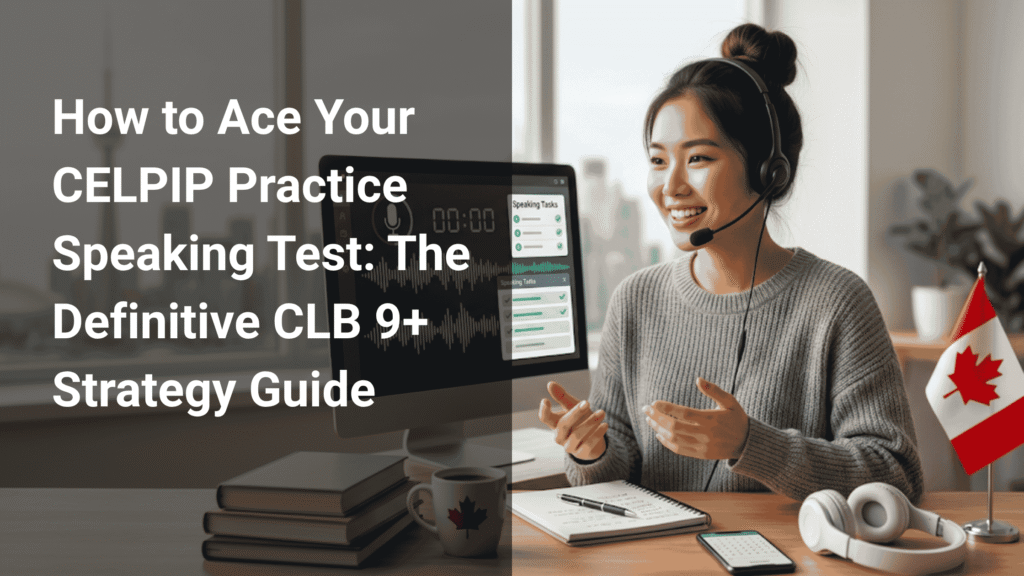
How to Ace Your CELPIP Practice Speaking Test: The Definitive CLB 9+ Strategy Guide

If you are preparing for the Canadian PR language test to boost your Express Entry Comprehensive Ranking System (CRS) score, you already know that every single point counts. For most immigration hopefuls, the Speaking module is the ultimate bottleneck. Speaking clearly into a computer mic in a room filled with other test-takers is highly unnatural. The secret to breaking through this anxiety is structured preparation using a high-quality celpip practice speaking test. To score a CLB 9 or higher, you cannot simply wing it with casual English. You need a formulaic, structured approach to each of the eight speaking tasks. In this comprehensive guide, our senior coaching team at Speak Infinite breaks down the exact strategies, task-by-task blueprints, and practice routines that turn average speakers into high-scoring candidates. Quick Answer: How to Get a CLB 9+ on the CELPIP Speaking Test? To achieve a CLB 9+ score, you must demonstrate structural organization, conversational naturalness, and zero content gaps. Deliver Structured Responses: Use clear transitional frameworks (e.g., “First and foremost,” “Consequently”). Maintain a Steady Pace: Speak at a conversational, rhythmic pace (110–130 words per minute) to minimize filler sounds like “uh” and “um”. Avoid Content Gaps: Answer every single prompt sub-question within the designated time limit. Practice Digitally: Consistently use a targeted celpip practice speaking test with an on-screen timer to build muscle memory. Table of Contents   What Is the CELPIP Speaking Test? The speaking module of the CELPIP General Test is a fully digitized evaluation. Unlike other examinations where you speak face-to-face with an interviewer, CELPIP requires you to speak into a headset microphone attached to a computer. Total Duration: Approximately 15–20 minutes. Structure: 8 distinct tasks, plus 1 unrated practice task at the beginning to test your microphone levels. Evaluation Model: Your recorded responses are sent securely to multiple human raters who evaluate your language skills based on four categories: Content/Coherence, Vocabulary, Listenability, and Task Fulfillment. Your scores are directly mapped to the Canadian Language Benchmark (CLB) levels, which are used directly by IRCC for Express Entry and PNP immigration pathways. Speaking Score vs. CLB Level CELPIP Level CLB Level Express Entry Competitive Standing 10 to 12 CLB 10+ Elite Profile (Max points unlocked) 9 CLB 9 Golden Target (Triggers skill transferability points) 8 CLB 8 Good, but misses critical bonus CRS multipliers 7 CLB 7 Bare minimum entry point for high-skilled pathways CELPIP Speaking Task Overview Before diving into individual strategies, let’s look at the overall structure of the speaking test: Task Number & Title Preparation Time Speaking Time Core Skill Evaluated Task 1: Giving Advice 30s 90s Providing structured, friendly recommendations Task 2: Talking about a Personal Experience 30s 60s Storytelling in past tenses with descriptive language Task 3: Describing a Scene 30s 60s Spatial description and prepositions Task 4: Making Predictions 30s 60s Using future tenses and expressing probability Task 5: Comparing and Persuading 60s 60s Comparative structures and persuasive reasoning Task 6: Dealing with a Difficult Situation 60s 60s Expressing empathy and offering solutions Task 7: Expressing an Opinion 30s 90s Logical argumentation and structured persuasion Task 8: Describing an Unusual Situation 30s 60s Advanced descriptive vocabulary for unfamiliar objects Deep-Dive: The 8 CELPIP Speaking Tasks To perform well on your celpip practice speaking test, you need a tailored approach for each of the eight modules. Task 1: Giving Advice Purpose: Offer helpful, practical recommendations to a friend, family member, or colleague in a warm, encouraging tone. Preparation: 30 seconds | Speaking: 90 seconds Sample Prompt: A friend wants to start exercising but has a busy schedule. Advise them on how to incorporate physical activity into their daily routine. Expert Strategy: Split your 90 seconds into three distinct advice points. Start with a friendly introduction (“Hey Mark, I heard you’re looking to…”), deliver your three points with supporting reasons using transitional phrases (“Firstly…”, “In addition to that…”, “Lastly…”), and wrap up with an encouraging closing (“I’m sure you’ll do great! Let me know if you need a workout partner.”). Common Mistake: Speaking too formally. This task requires a warm, supportive, and friendly tone. Task 2: Talking about a Personal Experience Purpose: Share a story about a past event from your life, focusing on narrative flow and accurate past tense verbs. Preparation: 30 seconds | Speaking: 60 seconds Sample Prompt: Talk about a memorable celebration or party that you attended. What was the occasion, and why was it special to you? Expert Strategy: Use the 5 Ws framework (Who, What, When, Where, Why) during your 30-second prep time to quickly organize your thoughts. Keep your sentences structured chronologically (“It all started when…”, “Shortly after that…”, “By the time the night ended…”). Common Mistake: Spending 45 seconds on the introduction and running out of time before explaining why the event was memorable. Task 3: Describing a Scene Purpose: Describe what is happening in a detailed illustration as if you are explaining it to someone who cannot see it. Preparation: 30 seconds | Speaking: 60 seconds Sample Prompt: Describe what you see in the provided picture of a busy outdoor farmers’ market. Expert Strategy: Use spatial prepositions to structure your description (“In the foreground…”, “To the right-hand side of the image…”, “Directly behind them…”). Focus on describing who is in the scene, what they are doing, and what they are wearing. Common Mistake: Making random, unorganized observations rather than guiding the listener through the picture systematically (e.g., moving from left to right, or foreground to background). Task 4: Making Predictions Purpose: Look at the same illustration from Task 3 and predict what will happen next based on visual clues. Preparation: 30 seconds | Speaking: 60 seconds Sample Prompt: Predict what will happen next in the farmers’ market scene. Expert Strategy: Use varied future tenses and terms of probability (“It appears that…”, “It is highly probable that…”, “She is about to…”). Connect your predictions directly to the visual clues in the image (“Since the boy is running toward the dog, I predict that…”). Common Mistake: Using simple

what is a good CELPIP score
CELPIP

What Is a Good CELPIP Score? The Ultimate 2026 Express Entry Strategy & Student Success Story

Navigating the pathways of Canadian immigration is an exciting journey, but it requires precision planning. If you want to build a life in Canada through economic immigration streams, demonstrating your English language proficiency isn’t just a basic checkbox—it’s the single most influential lever you can pull to increase your application’s ranking. The Canadian English Language Proficiency Index Program (CELPIP) has fast become the preferred language assessment for candidates worldwide. Because it uses local everyday scenarios and a completely digitized evaluation format, it removes a layer of test anxiety that traditional exams carry. Yet, as you prepare to book your test date, you face a critical question: What is a good CELPIP score? The reality is that a “passing” mark does not exist in the eyes of Immigration, Refugees and Citizenship Canada (IRCC). Instead, your results dictate how competitive your profile will look inside the highly selective Express Entry pool. In this definitive guide, the master training mentors at Speak Infinite break down the mechanics of the CELPIP grading matrix, demonstrate how a high score directly increases your Comprehensive Ranking System (CRS) points, and share a real-world case study of a student who turned his immigration timeline around. Decoding the 2026 CELPIP Scoring System & CLB Equivalencies One major advantage of selecting the CELPIP exam over alternative options like IELTS is the transparency of its grading system. CELPIP scores are deliberately calibrated on a direct 1-to-1 scale with the Canadian Language Benchmark (CLB) framework. When you receive your official results report, you will not have to calculate complex fractional bands. Instead, if you earn a level 9 in a specific section, it means your performance satisfies the exact criteria for a CLB 9 score. The system assesses four distinct modules: Listening, Reading, Writing, and Speaking. The CELPIP Raw Score to Level Mapping To understand how your test performance translates into an official level, it helps to examine how many correct answers you need on the multiple-choice sections. The Listening and Reading modules each contain 38 scored items. The official transformation scale indicates the performance bands required for each outcome: CELPIP Listening & Reading Official Conversion Chart Raw Score (Out of 38) – Listening Raw Score (Out of 38) – Reading Resulting CELPIP Level CLB Equivalence Target Competency Tier 35 – 38 33 – 38 Level 10 to 12 CLB 10+ Advanced to Fluent Mastery 33 – 34 31 – 32 Level 9 CLB 9 Highly Effective Professional 30 – 32 28 – 30 Level 8 CLB 8 Adequately Competent Operational 27 – 29 24 – 27 Level 7 CLB 7 Developing Professional Base 22 – 26 19 – 23 Level 6 CLB 6 Developing Functional 17 – 21 15 – 18 Level 5 CLB 5 Initial Professional / Basic Evaluating your current performance against these ranges using a premium, timed CELPIP practice test Canada framework is a smart first step to find out exactly where you stand before exam day. Defining the “Good” Benchmark Across Different Immigration Pathways To answer “what is a good CELPIP score,” you must first pinpoint the specific program you are applying for. IRCC modifies its language baseline depending on the economic or social category of the immigration pathway. The Minimum Threshold (CLB 7) If you intend to enter the Express Entry pool via the Federal Skilled Worker Program (FSWP) or the Canadian Experience Class (CEC) for high-skilled roles (TEER 0, 1, or 2), you must hit a minimum of CLB 7 across all four test components. Falling below a level 7 in even a single category means you cannot submit your profile, regardless of how impressive your university education or years of work history may be. The Skilled Trades Entry point (CLB 4 / 5) Candidates who apply through the Federal Skilled Trades Program (FSTP) operate under different standards. The entry criteria require a minimum level 5 in Listening and Speaking, alongside a minimum level 4 in Reading and Writing. The Citizenship Milestone (CLB 4) For residents who have already obtained permanent status and are moving forward with their official Canadian Citizenship application, the language barrier drops significantly. IRCC only requires proof of a CLB 4 or higher in the verbal communication sections. This requirement can be fulfilled by taking the streamlined CELPIP-General LS test, which entirely omits the Reading and Writing modules. Why a CLB 9 Score Is the Golden Target for Express Entry? While a level 7 makes you eligible to submit your profile, it rarely makes you competitive enough to secure an actual Invitation to Apply (ITA) in general immigration draws. In today’s landscape, achieving a CLB 9 score across all modules is the true baseline for PR success. The primary reason for this target lies in a hidden mechanism within the Express Entry CRS scoring system called Skill Transferability Factors. The CRS points calculator awards points across two distinct language categories: Core Points and Combination Points. When you reach a level 9 across all four components, your profile experiences an exponential mathematical boost. Core Language Points Allocation (Single Applicants) CELPIP Level 7: 17 points per module = 68 total points CELPIP Level 8: 23 points per module = 92 total points CELPIP Level 9: 31 points per module = 124 total points CELPIP Level 10+: 34 points per module = 136 total points Looking at the core point distribution alone, upgrading your performance from a level 7 to a level 9 gains you a clean 56 points. The Skill Transferability Multiplier Effect The real transformation occurs when your language results pair with your background credentials. IRCC rewards candidates whose language abilities allow them to easily integrate into the local workforce. Language + Post-Secondary Education: If your test results sit at a CLB 7 or 8, your university degree grants you modest combination points. The very moment every section hits a CLB 9, you instantly unlock up to 50 additional bonus points for your education profile. Language + Foreign Work Experience: A similar rule applies to international corporate background profiles. A baseline

CELPIP Reading Practice Test Canada
CELPIP

CELPIP Reading Practice Test: Tips to Improve Speed & Accuracy for a CLB 9+

For anyone looking to relocate, work, or settle down permanently in Canada, clearing the Canadian English Language Proficiency Index Program (CELPIP) with a high band is a major requirement. While many test-takers focus their energy on the productive modules like speaking and writing, it is often the reading section that quietly breaks a candidate’s overall profile. Navigating a continuous 55 to 60-minute window across complex, computer-based texts requires more than basic vocabulary—it demands elite pacing and zero margin for error. To help you get the most out of your study sessions, utilizing a targeted CELPIP Reading Practice Test is the absolute best way to isolate your mistakes before test day. However, simply reading text blocks over and over won’t improve your performance if you are consistently applying the wrong diagnostic methods. Below is an extensive, actionable guide compiled by the language instruction coaches at Speak Infinite to show you exactly how to bypass common traps, build exceptional scanning reflexes, and maximize your performance. Understanding the Official Architecture of the CELPIP Reading Section The reading component contains exactly 38 scored multiple-choice questions broken into four distinct parts. Every single question is hosted side-by-side with its passage on a digital screen, which means you never have to waste time flipping physical booklet pages. The 4-Part Structure Break Down: Part 1: Reading Correspondence (11 Questions): Typically an email or formal letter detailing everyday situations, followed by a response letter where you must fill in missing conceptual gaps. Part 2: Reading to Apply a Diagram (8 Questions): An interactive exercise where you look at a schedule, layout map, flyer, or corporate chart and answer questions by connecting the graphic details with text-based data. Part 3: Reading for Information (9 Questions): A long, purely factual article where you must match specific text statements directly to their correct paragraphs. Part 4: Reading for Viewpoints (10 Questions): The most complex part of the module, presenting an editorial debate or opinion piece where you must identify and differentiate subtle human perspectives and implied arguments. To excel across all four sections under a ticking clock, you should regularly benchmark your skills using a structured CELPIP Reading Practice Test Canada to safely familiarize yourself with this exact layout. Strategic Time Management Across the Four Parts The most widespread mistake candidates make on the exam is spending 15 minutes reading the first email in Part 1, leaving themselves completely starved for time by the time they hit the intricate texts of Part 4. Because each section has an independent, unyielding countdown timer, knowing when to move forward is essential. A premium, realistic CELPIP Reading Mock Test will train your brain to adapt to this strict breakdown: Recommended Section Pacing Matrix Part 1 (Correspondence): Target completion within 11 minutes (~60 seconds per question). Part 2 (Diagram Application): Target completion within 9 minutes (~65 seconds per question). Part 3 (Reading for Information): Target completion within 10 minutes (~65 seconds per question). Part 4 (Reading for Viewpoints): Target completion within 13 minutes (~75 seconds per question). Essential CELPIP Reading Tips to Skyrocket Speed and Accuracy If you want to move past a standard CLB 7 and cross into elite CLB 9+ territory, you must drop passive reading habits and adopt active, strategic scanning techniques: 1. Execute the “Question-First” Protocol Never read the entire block of text before glancing at the questions. Doing so forces you to hold arbitrary details in your short-term memory, wasting roughly 3 to 4 minutes per section. Instead, read the title to establish context, look directly at the first question, identify its unique anchors (like dates, names, or specific verbs), and then scan the passage with precision to locate the matching answer. 2. Differentiate Skimming vs. Scanning Skimming: Glancing over the first line of each paragraph to map out the overall logic layout of the article. Scanning: Using your eyes like a sniper scope to look for a specific phrase or keyword without actually absorbing the surrounding sentences word-for-word. 3. Identify and Neutralize Clever Synonym Distractors The test writers rarely repeat the exact words from the passage inside the correct multiple-choice bubble. If a text states that a company “downsized its workforce due to fiscal deficits,” the correct answer choice might say “staff reductions occurred due to monetary issues.” If you see an option that copies the exact phrasing from the paragraph word-for-word, look closer—it is often a distractor designed to trick careless readers. Using a high-quality CELPIP Reading Practice Test allows you to study these subtle paraphrasing traps extensively. 4. Rely Strictly on Explicit On-Screen Information Never inject your own personal knowledge, industry background, or real-world logic into your choices. If a text explicitly states that the sky is purple in a specific scientific study, then for the purpose of the exam, the sky is purple. Every single correct option can be verified by pointing a cursor directly at a sentence on the screen. Common Practice Mistakes to Eliminate From Your Routine Practicing Without an Active On-Screen Timer Reading articles casually on a tablet or phone will not prepare you for the pressure of the real exam. You must build your stamina by taking a full, timed CELPIP Reading Mock Test to ensure you can think clearly while the digital timer tracks your progress. Leaving Multiple-Choice Answers Blank The CELPIP grading engine does not apply negative marking or score penalties for incorrect answers. If you run into a highly confusing inference question in Part 4, make an educated guess, pick an option, and keep moving forward. Leaving a question completely blank guarantees a score of zero for that item, whereas a random choice gives you a 25% chance of keeping your score on track. Not Reviewing Your Mistake History The real secret to mastering a Free CELPIP Reading Practice Test isn’t just seeing your final raw score at the end. The value comes from spending 20 minutes reviewing every single wrong answer, understanding why you fell for the distractor, and tracing the correct pathway back to the paragraph

Blog

Ultimate Guide to Choosing the Best CELPIP Course in Canada (2026)

Picking the wrong CELPIP course; or worse, the wrong CELPIP test; can cost you months of delay and hundreds of dollars in retesting fees. This guide breaks down exactly how to choose a course that gets you the CLB score you actually need, starting with the one decision most applicants get wrong: General vs. General LS. The $290 Mistake Most Applicants Make Every year, thousands of Express Entry candidates book a CELPIP test, prepare hard, score well; and still get their application rejected. Not because their English wasn’t good enough, but because they took the wrong version of the test. CELPIP General LS is not accepted for Express Entry, yet many applicants confuse it with the full CELPIP General test and only discover the mistake after their results are useless for PR.e2language+1 If you’re prepping for CELPIP in 2026; whether you’re a nurse applying under a Provincial Nominee Program, an engineer chasing CLB 9 for extra CRS points, or a permanent resident applying for citizenship; choosing the right test, and then the right course, matters more than most institutes let on. The Problem: Too Many Choices, Not Enough Clarity Search “best CELPIP course in Canada” and you’ll get flooded with institutes promising “guaranteed CLB 9” and “band 10 in 30 days.” Almost none of them explain the single most important decision you need to make first: which CELPIP test do you actually need? This confusion leads to three common outcomes: Applicants pay full CELPIP General fees and prep for four skills when they only needed Listening and Speaking for citizenship. Applicants take the cheaper LS test assuming it works for Express Entry, then get their application returned. Applicants enroll in generic “one-size-fits-all” coaching that doesn’t tailor strategy by test type. Why This Matters CELPIP scores feed directly into your Canadian Language Benchmark (CLB) level, which determines your Express Entry Comprehensive Ranking System (CRS) points, PR eligibility, and even professional licensing for nurses, engineers, and other regulated professions. A single-point difference in CLB can be worth 20–50 CRS points; often the gap between an invitation to apply and another year of waiting.slideshare CELPIP General vs. CELPIP General LS: The Core Difference Here’s the shortcut I give every student on day one of assessment: ask yourself why you’re taking the test. That single question decides everything else. Feature CELPIP General CELPIP General LS Skills tested Listening, Reading, Writing, Speaking Listening and Speaking only celpip Purpose Express Entry, FSWP, CEC, PNPs, professional licensing, university admission celpip+1 Canadian citizenship applications only celpip Test duration ~3 hours celpip ~1 hour 10 minutes celpip Cost (Canada) ~CAD 290 + tax celpip ~CAD 195 + tax celpip Accepted for Express Entry? Yes No e2language Typical CLB requirement CLB 7+ across all four skills for most PR programs slideshare CLB 4 in Listening/Speaking for citizenship slideshare Best for PR applicants, job seekers, students, licensure candidates Existing PR holders applying for citizenship The rule of thumb: If you need Permanent Residency, take CELPIP General; no exceptions. CELPIP LS will not be accepted for Express Entry, regardless of how strong your listening and speaking scores are. If you already hold PR and only need citizenship, CELPIP LS saves you money and two full test sections.celpip+2 Real Student Example One student, a mechanical engineer, initially booked CELPIP LS because a friend called it “faster and cheaper.” During a free assessment, our trainers caught the mismatch immediately; his Express Entry profile required CELPIP General. Rebooking cost extra time, but catching the error before test day saved him a wasted attempt and a wasted $195. How to Choose the Best CELPIP Course in Canada: A Practical Framework Once you know which test you need, match your course to your actual gaps. Here’s how to evaluate any CELPIP institute; including us. 1. Trainer Expertise Specific to CELPIP Ask how long a trainer has specifically taught CELPIP, not “IELTS and CELPIP generally.” CELPIP has unique task formats; like Writing’s “Responding to Survey Questions”; that don’t exist in IELTS, so generalist trainers often miss important nuance. 2. Personalized Feedback, Not Generic Templates Score improvement in Writing and Speaking comes from feedback on your actual responses, not memorized templates. A strong course reviews your recorded speaking samples and marks writing against CELPIP’s real rubric. 3. Full-Length Mock Tests Under Timed Conditions CELPIP’s computer-based format and strict per-question timing catch many first-timers off guard. Look for courses offering official-format mock tests with detailed score breakdowns after each attempt. 4. Small Batch Sizes Speaking practice needs individual correction. Batches of 20–30 dilute attention;  smaller groups mean more speaking airtime and faster feedback per student. 5. Flexible Scheduling for Working Professionals Nurses on rotating shifts, engineers with deadlines, and working parents need evening, weekend, or self-paced options rather than a rigid classroom-only model. 6. Test-Specific Modules (General vs. LS) Since the two tests demand different skills, a good course offers a dedicated LS-only intensive rather than forcing every student through Reading and Writing modules they don’t actually need. CELPIP vs. IELTS vs. PTE: Confirm CELPIP Is Right for You Before committing to a CELPIP course, it’s worth checking whether CELPIP is genuinely your best-fit test.ielts Factor CELPIP IELTS PTE Core Accent North American English only Test-taker’s natural accent Test-taker’s natural accent Speaking format Computer-recorded, no live examiner Face-to-face with human examiner Computer-recorded Writing input Typed on keyboard Handwritten or typed (computer-delivered) Typed IRCC accepted for PR Yes Yes Yes Best suited for Comfort with typing and North American vocabulary Comfort speaking to a live person Fast results, consistent AI scoring There’s no universally “easiest” test; it depends on your accent familiarity, typing comfort, and speaking style under pressure. A free assessment can diagnose which test genuinely suits your strengths before you spend money prepping for the wrong one. Study Pathway vs. PR Pathway: Where CELPIP Fits CELPIP scores matter differently depending on whether you’re entering Canada as a student or applying directly for PR. Pathway Role of CELPIP Typical Route Study Permit → PGWP → PR English score for

Scroll to Top