
If you are preparing for the Canadian PR language test to boost your Express Entry Comprehensive Ranking System (CRS) score, you already know that every single point counts. For most immigration hopefuls, the Speaking module is the ultimate bottleneck. Speaking clearly into a computer mic in a room filled with other test-takers is highly unnatural.
The secret to breaking through this anxiety is structured preparation using a high-quality celpip practice speaking test.
To score a CLB 9 or higher, you cannot simply wing it with casual English. You need a formulaic, structured approach to each of the eight speaking tasks.
In this comprehensive guide, our senior coaching team at Speak Infinite breaks down the exact strategies, task-by-task blueprints, and practice routines that turn average speakers into high-scoring candidates.
Quick Answer: How to Get a CLB 9+ on the CELPIP Speaking Test?
To achieve a CLB 9+ score, you must demonstrate structural organization, conversational naturalness, and zero content gaps.
Deliver Structured Responses: Use clear transitional frameworks (e.g., “First and foremost,” “Consequently”).
Maintain a Steady Pace: Speak at a conversational, rhythmic pace (110–130 words per minute) to minimize filler sounds like “uh” and “um”.
Avoid Content Gaps: Answer every single prompt sub-question within the designated time limit.
Practice Digitally: Consistently use a targeted celpip practice speaking test with an on-screen timer to build muscle memory.
Table of Contents
What Is the CELPIP Speaking Test?
The speaking module of the CELPIP General Test is a fully digitized evaluation. Unlike other examinations where you speak face-to-face with an interviewer, CELPIP requires you to speak into a headset microphone attached to a computer.
Total Duration: Approximately 15–20 minutes.
Structure: 8 distinct tasks, plus 1 unrated practice task at the beginning to test your microphone levels.
Evaluation Model: Your recorded responses are sent securely to multiple human raters who evaluate your language skills based on four categories: Content/Coherence, Vocabulary, Listenability, and Task Fulfillment.
Your scores are directly mapped to the Canadian Language Benchmark (CLB) levels, which are used directly by IRCC for Express Entry and PNP immigration pathways.
Speaking Score vs. CLB Level
| CELPIP Level | CLB Level | Express Entry Competitive Standing |
| 10 to 12 | CLB 10+ | Elite Profile (Max points unlocked) |
| 9 | CLB 9 | Golden Target (Triggers skill transferability points) |
| 8 | CLB 8 | Good, but misses critical bonus CRS multipliers |
| 7 | CLB 7 | Bare minimum entry point for high-skilled pathways |
CELPIP Speaking Task Overview
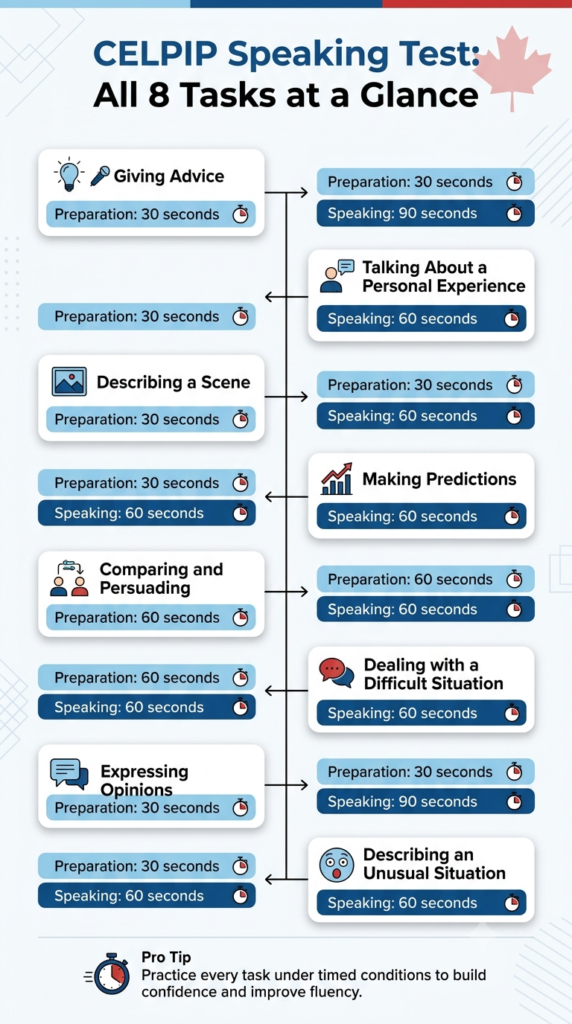
Before diving into individual strategies, let’s look at the overall structure of the speaking test:
| Task Number & Title | Preparation Time | Speaking Time | Core Skill Evaluated |
| Task 1: Giving Advice | 30s | 90s | Providing structured, friendly recommendations |
| Task 2: Talking about a Personal Experience | 30s | 60s | Storytelling in past tenses with descriptive language |
| Task 3: Describing a Scene | 30s | 60s | Spatial description and prepositions |
| Task 4: Making Predictions | 30s | 60s | Using future tenses and expressing probability |
| Task 5: Comparing and Persuading | 60s | 60s | Comparative structures and persuasive reasoning |
| Task 6: Dealing with a Difficult Situation | 60s | 60s | Expressing empathy and offering solutions |
| Task 7: Expressing an Opinion | 30s | 90s | Logical argumentation and structured persuasion |
| Task 8: Describing an Unusual Situation | 30s | 60s | Advanced descriptive vocabulary for unfamiliar objects |
Deep-Dive: The 8 CELPIP Speaking Tasks
To perform well on your celpip practice speaking test, you need a tailored approach for each of the eight modules.
Task 1: Giving Advice
Purpose: Offer helpful, practical recommendations to a friend, family member, or colleague in a warm, encouraging tone.
Preparation: 30 seconds | Speaking: 90 seconds
Sample Prompt: A friend wants to start exercising but has a busy schedule. Advise them on how to incorporate physical activity into their daily routine.
Expert Strategy: Split your 90 seconds into three distinct advice points. Start with a friendly introduction (“Hey Mark, I heard you’re looking to…”), deliver your three points with supporting reasons using transitional phrases (“Firstly…”, “In addition to that…”, “Lastly…”), and wrap up with an encouraging closing (“I’m sure you’ll do great! Let me know if you need a workout partner.”).
Common Mistake: Speaking too formally. This task requires a warm, supportive, and friendly tone.
Task 2: Talking about a Personal Experience
Purpose: Share a story about a past event from your life, focusing on narrative flow and accurate past tense verbs.
Preparation: 30 seconds | Speaking: 60 seconds
Sample Prompt: Talk about a memorable celebration or party that you attended. What was the occasion, and why was it special to you?
Expert Strategy: Use the 5 Ws framework (Who, What, When, Where, Why) during your 30-second prep time to quickly organize your thoughts. Keep your sentences structured chronologically (“It all started when…”, “Shortly after that…”, “By the time the night ended…”).
Common Mistake: Spending 45 seconds on the introduction and running out of time before explaining why the event was memorable.
Task 3: Describing a Scene
Purpose: Describe what is happening in a detailed illustration as if you are explaining it to someone who cannot see it.
Preparation: 30 seconds | Speaking: 60 seconds
Sample Prompt: Describe what you see in the provided picture of a busy outdoor farmers’ market.
Expert Strategy: Use spatial prepositions to structure your description (“In the foreground…”, “To the right-hand side of the image…”, “Directly behind them…”). Focus on describing who is in the scene, what they are doing, and what they are wearing.
Common Mistake: Making random, unorganized observations rather than guiding the listener through the picture systematically (e.g., moving from left to right, or foreground to background).
Task 4: Making Predictions
Purpose: Look at the same illustration from Task 3 and predict what will happen next based on visual clues.
Preparation: 30 seconds | Speaking: 60 seconds
Sample Prompt: Predict what will happen next in the farmers’ market scene.
Expert Strategy: Use varied future tenses and terms of probability (“It appears that…”, “It is highly probable that…”, “She is about to…”). Connect your predictions directly to the visual clues in the image (“Since the boy is running toward the dog, I predict that…”).
Common Mistake: Using simple future tense (“He will do this, she will do that”) repeatedly, which limits your vocabulary score.
Task 5: Comparing and Persuading
Purpose: Select one option from two choices and persuade a family member or colleague why your choice is the better option.
Preparation: 60 seconds | Speaking: 60 seconds
Sample Prompt: Persuade your spouse to choose a quiet suburban house over an expensive downtown apartment.
Expert Strategy: State your choice clearly right at the start. Instead of simply listing the benefits of your choice, directly compare the two options using comparative grammar (“While the apartment is closer to work, the house offers much more space for our kids…”).
Common Mistake: Only talking about your chosen option while ignoring the alternative choice entirely.
Task 6: Dealing with a Difficult Situation
Purpose: Deliver difficult news or resolve a conflict while balancing empathy with clear, practical solutions.
Preparation: 60 seconds | Speaking: 60 seconds
Sample Prompt: You promised to help your sister move this weekend, but your boss just asked you to work overtime. Explain the situation to your sister and offer a solution.
Expert Strategy: Start by acknowledging the situation and expressing sincere empathy (“Hey Sarah, I’m really sorry to bring this up, but…”). Present your reason clearly, then propose two realistic alternative solutions (“To make it up to you, I can either pay for a professional moving service or help you all day on Sunday instead…”).
Common Mistake: Sounding cold or failing to offer any practical alternatives to resolve the conflict.
Task 7: Expressing an Opinion
Purpose: Present a clear, well-supported argument on a social issue, working environment, or community policy.
Preparation: 30 seconds | Speaking: 90 seconds
Sample Prompt: Do you believe that remote work should remain a permanent option for all office employees? Explain your view.
Expert Strategy: Take a clear side immediately—avoid sitting on the fence. Structure your 90 seconds like a mini-essay: an introduction with a clear thesis, two body points backed by real-world examples, and a brief conclusion.
Common Mistake: Repeating the same point in different words rather than introducing new, distinct supporting arguments.
Task 8: Describing an Unusual Situation
Purpose: Describe a strange, unique, or complex object shown on your screen to a friend or store clerk who cannot see it.
Preparation: 30 seconds | Speaking: 60 seconds
Sample Prompt: You are in an art gallery and see an unusual sculpture. Phone your art-loving friend and describe it so they can visualize it.
Expert Strategy: Use analogies, shapes, and materials to describe the object (“It’s a metallic object shaped like a spiral…”, “It resembles a miniature satellite dish, but with…”). Group your description from the outside-in or top-to-bottom.
Common Mistake: Panicking because you don’t know the exact technical name of the object. The raters are testing your ability to describe around unknown words.
Step-by-Step Guide: 15 Strategies to Ace Your Speaking Test
To turn your next celpip practice speaking test session into a high-scoring run, apply these 15 practical strategies:
Speak Naturally: Avoid sounding like you are reading a memorized script. Maintain an authentic, conversational flow.
Use Strategic Transition Words: Connect your ideas smoothly using markers like “In addition,” “Consequently,” or “Conversely”.
Use Your Prep Time Wisely: Do not write out full sentences on your scratch paper. Instead, jot down 3–4 key bullet points to guide your response.
Expand Your Answers: Always follow up a statement with a supportive “because” or “for instance” to provide deeper context.
Minimize Filler Sounds: If you need a moment to think, pause silently rather than filling the space with “uhm,” “err,” or “like”.
Focus on Clear Pronunciation: Pronounce word endings clearly (especially past tense “ed” and plural “s”).
Use Varied Vocabulary: Avoid repeating the same words. Use synonyms to show the breadth of your vocabulary.
Practice with Strict Timers: Get used to the exact on-screen preparation and speaking countdowns.
Record Your Practice Sessions: Always record your responses during practice to listen for pacing, volume, and clarity.
Shadow Native Speakers: Improve your natural rhythm, intonation, and stress patterns by mimicking native Canadian English speakers.
Organize Responses Quickly: Build a library of reliable transition phrases so you don’t have to think about how to start your sentences.
Maintain Fluency Over Absolute Grammar: If you make a minor mistake, keep going. Correcting yourself constantly does more harm to your fluency score than a minor grammatical slip.
Self-Correct with Care: Only correct yourself if you can do it quickly and naturally (“Excuse me, what I meant was…”). Otherwise, keep moving forward.
Manage Test-Day Nerves: Take slow, deep breaths during the preparation countdown to keep your heart rate steady and voice clear.
Practice Daily: Consistent 20-minute daily speaking sessions are much more effective than long, exhausting weekly cram sessions.
Common Mistakes That Lower Your Score
Many candidates with strong English skills fail to secure a CLB 9+ because they fall into common test-taking traps.
Common Mistakes vs. Solutions
| What Most Candidates Do (The Mistake) | What You Should Do Instead (The Solution) |
| Speaking too fast to fit in more information. | Speak at a steady, conversational pace to reduce pronunciation errors and keep your flow natural. |
| Speaking too slowly or using long pauses to think. | Use structured transition templates to bridge your thoughts smoothly. |
| Repeating the same point over and over in different ways. | Use your preparation time to list 2 or 3 distinct supporting points. |
| Over-using complex grammar that leads to errors. | Stick to clear, compound, and complex sentence structures that you are completely comfortable with. |
| Losing track of the on-screen timer. | Keep your eyes on the countdown and start your conclusion when you have 10 seconds remaining. |
Best Ways to Practice Your Speaking Test
A successful preparation strategy balances self-directed practice with professional guidance.
1. Take Advantage of Authentic Practice Tests
The single most effective way to build confidence is by regularly taking a realistic celpip practice speaking test. This familiarizes you with the computerized layout, headset recording, and strict time limits of the actual exam.
2. Record and Analyze Yourself Daily
Use your phone to record your practice sessions. When playing them back, evaluate your responses using this checklist:
Did I complete the task in the given time?
Did I use too many filler words?
Is my voice clear and easy to understand?
3. Seek Professional Feedback
While self-study is great for building confidence, you cannot accurately grade your own pronunciation, grammar, or task fulfillment. Enrolling in a targeted CELPIP course Canada gives you access to certified instructors who can pinpoint your weaknesses and help you improve.
Why Mock Speaking Tests Matter
Regular, timed mock exams are key to shifting your mindset from casual conversation to focused test performance:
Pacing and Time Management: Helps you naturally sense when you have 15 seconds left to wrap up your thoughts.
Adapting to Classroom Noise: Mimics the busy atmosphere of a real test center, helping you stay focused on your own screen.
Reducing Hesitation: Builds the quick-thinking skills needed to organize your ideas within the brief 30-second preparation window.
When Shivam first reached out to Speak Infinite, his Express Entry work permit was set to expire in less than six months. He was working as a logistics manager in Regina, Saskatchewan, and needed to hit a CLB 9 on his CELPIP General Test to secure an Invitation to Apply (ITA) for Canadian Permanent Residency.
Unfortunately, Shivam was stuck. He had already taken the exam twice on his own, scoring a level 7 in Speaking both times.
The Diagnostic
Our team reviewed his practice recordings and quickly identified two main issues:
The Over-Explanation Habit: In Task 1 and Task 7, Shivam got so caught up in the details of his first point that the timer ran out before he could present his other arguments.
Monotone Intonation: He spoke in a flat, monotone voice, which the computer grading software flagged as robotic, lowering his pronunciation and naturalness score.
The Action Plan
We enrolled Shivam in our intensive best CELPIP course program and put a targeted plan in place:
We used our CELPIP practice test Canada platform to run timed drills focusing purely on transitions.
We trained him on vocal variety exercises, showing him how to use natural stress and intonation to highlight key points.
We gave him simple structural templates for each task so he could organize his ideas in seconds.
The Breakthrough Result
After five weeks of personalized coaching, Shivam took the CELPIP exam again. This time, he walked out of the test center feeling confident—and his results reflected the hard work he had put in.
| Module | CELPIP Score |
|---|---|
| Listening | 10 |
| Reading | 10 |
| Writing | 9 |
| Speaking | 10 |
By achieving a CLB 10 in Speaking and strong scores across all four modules, Shivam gained an additional 78 CRS points in his Express Entry profile. The higher score significantly improved his ranking, and he received his Invitation to Apply (ITA) the following month. Today, Shivam is a proud Canadian Permanent Resident, proving that the right preparation and expert guidance can make all the difference.
Why Choose Speak Infinite?
If you are looking for structured, high-quality CELPIP coaching that delivers real results, Speak Infinite is here to help.
Certified Instructors: Learn from experienced, native-level language trainers who understand the details of the scoring rubric.
Personalized Evaluation: Receive detailed, written feedback and audio score breakdowns on your writing and speaking tasks.
Flexible Online Classes: Access our premium CELPIP online coaching sessions from anywhere in Canada or worldwide, structured around your busy schedule.
Comprehensive Study Resources: Get access to our exclusive database of practice tests, vocabulary guides, and masterclass webinars.
15 Expert Tips for Scoring CLB 9+
Vary Your Sentence Openers: Avoid starting every sentence with “I think” or “We should”. Use introductory clauses instead.
Use Natural Vocabulary: Use precise, everyday terms (e.g., “cost-effective” instead of “very cheap”).
Ensure Task Fulfillment: Read the prompt carefully and answer every single sub-question asked.
Emphasize Key Words: Use natural sentence stress to highlight your main points.
Use Parallel Structure: Keep your lists grammatically balanced (“running, swimming, and hiking” rather than “running, to swim, and hiking”).
Keep Your Tone Appropriate: Adjust your language depending on whether you are speaking to a friend, colleague, or official.
Choose a Side Quickly: In Task 7, pick the side that is easiest to defend with simple arguments, even if it isn’t your personal opinion.
Vary Your Transition Words: Mix up your connectors (use “Furthermore,” “On the other hand,” “Consequently”).
Speak with Confidence: A confident, steady tone naturally sounds more fluent and authoritative.
Practice Describing Random Objects: Build your Task 8 skills by describing odd items around your home in under 60 seconds.
Organize Your Notes Visually: Use simple symbols (like arrows or plus signs) on your scratch paper to save time during prep.
Master the 5-Second Conclusion: Have a go-to closing line ready for each task so you can wrap up smoothly as the timer runs down.
Don’t Worry About Your Accent: Focus on clear pronunciation and natural rhythm rather than trying to sound like a native speaker.
Listen to the Instructions Carefully: Use the instruction screens to catch your breath, relax, and prepare for the next task.
Use High-Quality Practice Tools: Practice with realistic CELPIP preparation Canada resources that match the formatting and timing of the actual exam.
Suggested Weekly Practice Plan
To make your study routine highly effective, here is a structured weekly plan you can follow:
| Day of the Week | Core Practice Focus | Actionable Practice Task |
| Monday | Task 1 & Task 2 | Practice giving friendly advice and sharing structured personal stories using a timer. |
| Tuesday | Task 3 & Task 4 | Work on describing detailed scenes and making predictions based on visual clues. |
| Wednesday | Task 5 & Task 6 | Practice comparing options and handling difficult personal or professional situations. |
| Thursday | Task 7 & Task 8 | Focus on expressing clear opinions on social issues and describing unusual objects. |
| Friday | Full Mock Test | Take a complete, timed celpip practice speaking test to build stamina and track your progress. |
| Saturday | Review & Coaching | Listen to your recordings, note any areas for improvement, or get professional feedback from your coach. |
| Sunday | Rest & Recharge | Take a break to keep your mind fresh and ready for the week ahead. |
Reach Your Language Goals with Speak Infinite
Mastering the speaking section of the CELPIP test is all about using the right strategies, practicing consistently, and getting expert guidance to polish your skills.
At Speak Infinite, we offer specialized CELPIP Course Canada programs designed to help you reach your target scores. Whether you need structured study guides, detailed mock tests, or personalized, one-on-one coaching, our team is here to support you every step of the way.
Don’t let a low speaking score hold back your Canadian immigration journey. Take the first step today, improve your practice routine, and get ready to ace your exam.
Book Your Free CELPIP Diagnostics Session with Speak Infinite Today!
Most Asked Questions
Don't panic if the timer ends before you've completed your response. CELPIP raters evaluate your overall fluency, organization, grammar, vocabulary, and communication skills. While it's ideal to finish with a brief conclusion, missing your final sentence won't significantly affect your score if the rest of your response is clear, well-structured, and complete.
The CELPIP Speaking test is assessed by certified human raters. Your responses are recorded digitally and evaluated based on factors such as fluency, pronunciation, vocabulary, grammar, coherence, and task completion to ensure fair and accurate scoring.
Place the headset microphone approximately two fingers away from your mouth, slightly to one side rather than directly in front. This helps reduce breathing noises while ensuring your voice is recorded clearly throughout the test.
For most Express Entry applicants, a CELPIP Level 9 (CLB 9) or higher in all four modules is considered an excellent score. Although CLB 7 meets the minimum eligibility for many immigration programs, achieving CLB 9 can unlock valuable skill transferability points and significantly improve your CRS score.
It's best not to. Once you've chosen an option, stay with your decision and focus on explaining it confidently. Changing your mind midway can interrupt your fluency, waste valuable speaking time, and make your response less organized.
If you encounter an unfamiliar word, don't panic. Use the surrounding context to make an educated guess and continue speaking naturally. Maintaining your confidence and fluency is far more important than stopping to analyze a single word.
Practice using a mix of simple, compound, and complex sentences during your daily speaking exercises. Regular mock tests, self-recordings, and professional feedback will help you use grammar more naturally and confidently under exam conditions.
Speak in a clear, natural conversational voice. There's no need to raise your voice, as the headset microphone is designed to capture your speech accurately. Speaking too loudly may affect your comfort and pronunciation.
For the best results, aim to complete at least two full speaking mock tests each week during your preparation. Regular mock exams improve your fluency, confidence, time management, pronunciation, and familiarity with the test format, helping you perform more effectively on exam day.
Read More Blogs
Explore expert CELPIP, IELTS strategies, tips, and study guides.
How to Ace Your CELPIP Practice Speaking Test: The Definitive CLB 9+ Strategy Guide
If you are preparing for the Canadian PR language test to boost your Express Entry Comprehensive Ranking System (CRS) score, you already know that every…

What Is a Good CELPIP Score? The Ultimate 2026 Express Entry Strategy & Student Success Story
Navigating the pathways of Canadian immigration is an exciting journey, but it requires precision planning. If you want to build a life in Canada through…

CELPIP Reading Practice Test: Tips to Improve Speed & Accuracy for a CLB 9+
For anyone looking to relocate, work, or settle down permanently in Canada, clearing the Canadian English Language Proficiency Index Program (CELPIP) with a high band…