
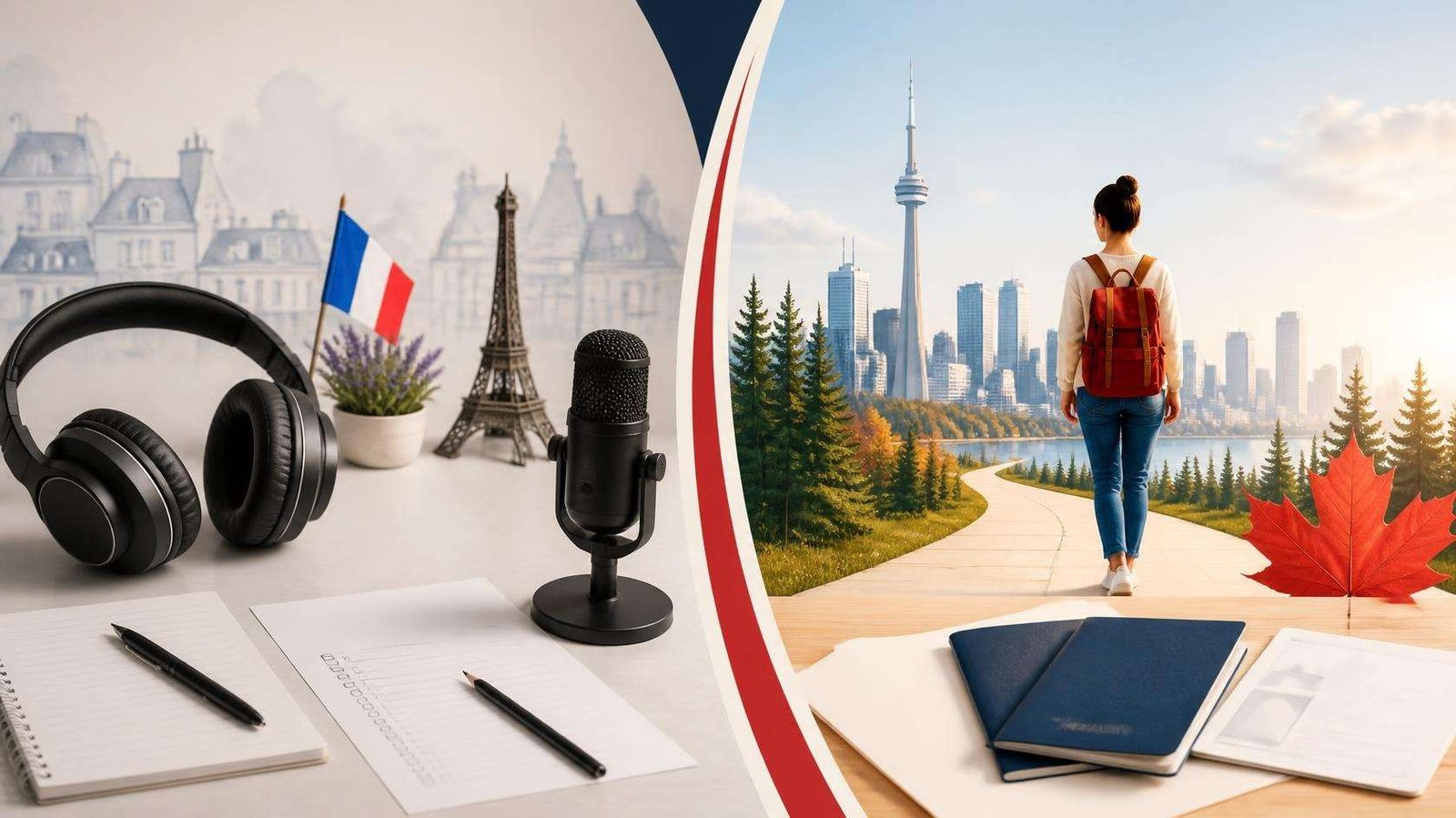
WHY FRENCH MATTERS RIGHT NOW?
Since IRCC removed arranged-employment-offer points from the CRS in March 2025, French has become one of the few “controllable” levers left in Express Entry — something a candidate can actively study for and improve. French can add up to 50 points to a candidate’s Express Entry CRS score, and since IRCC removed arranged employment offer points from the CRS in March 2025, French proficiency has become one of the most powerful and controllable ways to boost a score.
Both tests are official IRCC-recognized options: TEF Canada and TCF Canada are both officially recognised by Immigration, Refugees and Citizenship Canada as proof of French language proficiency, and both convert scores to NCLC (Niveaux de compétence linguistique canadiens) levels, the framework used to calculate CRS points in Express Entry.
TEF Canada vs TCF Canada is one of the most common questions asked by candidates planning to immigrate to Canada through Express Entry.
If you are preparing for Canadian immigration and want to use French as an official language, you may be wondering:
- Should I take TEF Canada or TCF Canada?
- Is TEF Canada easier than TCF Canada?
- Which test gives a better chance of achieving NCLC 7?
- What are the differences in the exam format?
- How are TEF and TCF scores converted to NCLC levels?
- Can French improve my Express Entry CRS score?
- Which test should I choose for Canadian immigration?
The important point is that both TEF Canada and TCF Canada are officially accepted by Immigration, Refugees and Citizenship Canada (IRCC) for Express Entry. The two tests assess the same four major language abilities—listening, reading, writing and speaking—but their formats, question structures and scoring systems are different.
Therefore, instead of asking which test is universally “better”, candidates should ask:
Which test format suits my French level, preparation style and test-taking strengths?
This guide from SPEAK INFINITE explains the differences clearly so that you can make an informed choice.
WHAT IS TEF CANADA?
TEF Canada stands for Test d’évaluation de français pour le Canada.
It is a French-language proficiency test administered by Le français des affaires of the CCI Paris Île-de-France and is officially recognized for Canadian immigration and citizenship purposes.
TEF Canada has been recognized by the Canadian government for immigration purposes since 2002. The test provider states that TEF Canada is officially recognized by the Government of Canada for immigration and citizenship procedures.
For Express Entry, candidates must take the appropriate TEF Canada version and obtain results for the four required language abilities.
The four TEF Canada skills
- Compréhension écrite – Reading
- Compréhension orale – Listening
- Expression écrite – Writing
- Expression orale – Speaking
For immigration applications, all four components are required. The current TEF Canada format listed by the official test provider consists of:
|
Skill |
Format |
Duration |
|---|---|---|
|
Reading |
40 questions |
60 minutes |
|
Listening |
40 questions |
40 minutes |
|
Writing |
2 tasks |
60 minutes |
|
Speaking |
2 tasks |
15 minutes |
The total testing time is approximately 175 minutes, although the actual appointment may take longer because of administrative procedures.
WHAT IS TCF CANADA?
TCF Canada stands for Test de connaissance du français pour le Canada.
It is administered by France Éducation international.
TCF Canada was specifically designed for people who need to demonstrate French proficiency for Canadian immigration or Canadian citizenship procedures.
Like TEF Canada, TCF Canada evaluates four skills:
- Compréhension orale – Listening
- Compréhension écrite – Reading
- Expression écrite – Writing
- Expression orale – Speaking
The official TCF Canada format consists of four compulsory components:
|
Skill |
Format |
Duration |
|---|---|---|
|
Listening |
39 multiple-choice questions |
35 minutes |
|
Reading |
39 multiple-choice questions |
60 minutes |
|
Writing |
3 tasks |
60 minutes |
|
Speaking |
3 tasks |
12 minutes |
The total examination time is approximately 2 hours 47 minutes.
TEF CANADA VS TCF CANADA: QUICK COMPARISON
Here is a simple comparison for Canadian immigration candidates.
|
Feature |
TEF Canada |
TCF Canada |
|---|---|---|
|
Full name |
Test d’évaluation de français |
Test de connaissance du français |
|
Main organization |
CCI Paris Île-de-France / Le français des affaires |
France Éducation international |
|
Accepted by IRCC |
Yes |
Yes |
|
Reading |
40 questions |
39 questions |
|
Listening |
40 questions |
39 questions |
|
Writing |
2 tasks |
3 tasks |
|
Speaking |
2 tasks |
3 tasks |
|
Reading duration |
60 min |
60 min |
|
Listening duration |
40 min |
35 min |
|
Writing duration |
60 min |
60 min |
|
Speaking duration |
15 min |
12 min |
|
Four skills required for Express Entry |
Yes |
Yes |
|
NCLC equivalency |
Yes |
Yes |
|
Result validity for Express Entry |
2 years |
2 years |
Both tests are accepted by IRCC, so there is no immigration advantage simply because you selected TEF rather than TCF, or TCF rather than TEF. What matters is the NCLC level achieved in each skill and whether the result satisfies the requirements of your immigration pathway.
IS TEF CANADA EASIER THAN TCF CANADA?
This is probably the most frequently asked question.
The answer is:
Neither test is officially designated as “easier.”
TEF Canada and TCF Canada use different question formats, task structures and scoring systems. A candidate may personally find one format more comfortable than the other.
For example:
A candidate may prefer TEF Canada if:
- They are comfortable with the TEF question style.
- They perform well with the TEF reading and listening format.
- They are comfortable completing two writing tasks.
- They prefer two speaking tasks.
A candidate may prefer TCF Canada if:
- They are comfortable with the TCF multiple-choice format.
- They prefer shorter listening and speaking components.
- They are comfortable handling three writing tasks.
- They prefer the TCF speaking structure.
The important lesson is:
Do not choose a test simply because someone says it is easier.
Your result depends on your French proficiency, vocabulary, grammar, comprehension, speaking ability, writing ability, time management and familiarity with the particular test format.
This is why SPEAK INFINITE recommends taking diagnostic practice tests for both formats before deciding.
WHAT IS NCLC?
If you are preparing for Canadian immigration, you need to understand NCLC.
NCLC means:
Niveaux de compétence linguistique canadien
It is the Canadian benchmark system used to evaluate French language proficiency.
For English, Canada uses CLB – Canadian Language Benchmarks.
For French, Canada uses NCLC.
Your TEF Canada or TCF Canada results are mapped to the corresponding NCLC levels.
For Express Entry, it is important to understand that immigration authorities do not simply look at your overall French ability. Your results are considered skill by skill.
The four skills are:
- Listening
- Reading
- Writing
- Speaking
WHY IS NCLC 7 IMPORTANT?
NCLC 7 is an important target for many Express Entry candidates.
For the Federal Skilled Worker Program, the minimum French level as a first official language is NCLC 7 in all four language abilities.
NCLC 7 is also particularly important because Canada has a French-language proficiency category under Express Entry.
To qualify for the French-language proficiency category, candidates must have a French test result showing at least NCLC 7 in all four language abilities, along with the other requirements applicable to the round and Express Entry system.
This means that getting:
- NCLC 7 in listening
- NCLC 7 in reading
- NCLC 7 in writing
- NCLC 7 in speaking
is much more significant for immigration purposes than simply saying:
“My French is around B2.”
The actual test results matter.
TEF CANADA NCLC 7 SCORE REQUIREMENTS
For Express Entry, IRCC’s current equivalency table shows the following TEF Canada ranges for NCLC 7:
|
Skill |
NCLC 7 – TEF Canada |
|---|---|
|
Speaking |
310–348 |
|
Listening |
249–279 |
|
Reading |
207–232 |
|
Writing |
310–348 |
IRCC also provides higher ranges for NCLC 8 and NCLC 9+.
NCLC 8
|
Skill |
TEF Canada |
|---|---|
|
Speaking |
349–370 |
|
Listening |
280–297 |
|
Reading |
233–247 |
|
Writing |
349–370 |
NCLC 9+
|
Skill |
TEF Canada |
|---|---|
|
Speaking |
371+ |
|
Listening |
298+ |
|
Reading |
248+ |
|
Writing |
371+ |
IMPORTANT: Candidates should always enter the appropriate scores from their official TEF result documentation as instructed by IRCC. IRCC specifically warns that TEF result documents may contain different score columns and that the appropriate scores must be entered in the Express Entry profile.
TCF Canada NCLC 7 Score Requirements
For TCF Canada, the numerical scoring system is different.
For NCLC 7, IRCC currently gives the following equivalencies:
|
Skill |
NCLC 7 – TCF Canada |
|---|---|
|
Speaking |
10–11 |
|
Listening |
458–502 |
|
Reading |
453–498 |
|
Writing |
10–11 |
For NCLC 8:
|
Skill |
TCF Canada |
|---|---|
|
Speaking |
12–13 |
|
Listening |
503–522 |
|
Reading |
499–523 |
|
Writing |
12–13 |
For NCLC 9+:
|
Skill |
TCF Canada |
|---|---|
|
Speaking |
14+ |
|
Listening |
523+ |
|
Reading |
524+ |
|
Writing |
14+ |
These are the current equivalencies published by IRCC.
DOES FRENCH GIVE EXTRA CRS POINTS?
Yes.
French proficiency can contribute significantly to an Express Entry candidate’s Comprehensive Ranking System (CRS) profile.
Under the current CRS criteria, candidates who achieve NCLC 7 or higher in all four French skills can receive additional CRS points depending on their English-language results:
- 25 additional points if NCLC 7+ is achieved in all four French abilities and English is CLB 4 or lower, or no English test is taken.
- 50 additional points if NCLC 7+ is achieved in all four French abilities and English is CLB 5 or higher in all four abilities.
Therefore, French can be an important part of an Express Entry strategy for eligible candidates.
However, French-test results are only one part of the immigration process. CRS also considers other factors such as age, education, work experience and other eligible factors.
TEF CANADA VS TCF CANADA: WHICH ONE SHOULD YOU CHOOSE?
Rather than saying that one test is universally better, consider the following factors.
- Your preferred question format
If you perform better with one test’s question structure during practice, that can be an important consideration.
Try both.
Complete a sample listening test.
Complete a sample reading test.
Try a writing task.
Try a speaking simulation.
Then compare your performance.
- Your speaking ability
Speaking is extremely important because you need to demonstrate your ability to communicate spontaneously and appropriately in French.
Do not prepare only grammar.
For NCLC 7 and above, candidates should practise:
- giving opinions
- explaining reasons
- describing situations
- comparing alternatives
- persuading
- asking questions
- responding spontaneously
- developing arguments
- connecting ideas logically
At SPEAK INFINITE, speaking preparation should therefore go beyond memorising model answers.
The goal should be to develop flexible French that can be adapted to different situations.
- Your writing ability
Writing is another area where candidates need structured preparation.
You should practise:
Grammar
- verb conjugation
- agreement
- articles
- pronouns
- prepositions
- sentence structure
- connectors
Vocabulary
Develop vocabulary related to:
- work
- education
- environment
- technology
- health
- transportation
- society
- family
- lifestyle
- immigration
- culture
- economy
Organisation
A good response should have:
Introduction → Development → Examples/Arguments → Conclusion
Candidates should also learn how to use French connectors such as:
- tout d’abord
- ensuite
- de plus
- cependant
- pourtant
- en revanche
- par conséquent
- en effet
- ainsi
- finalement
- pour conclure
- Your listening ability
French listening can be challenging because native speakers may speak quickly and use:
- contractions
- informal expressions
- linking sounds
- different accents
- everyday vocabulary
- fillers
- conversational expressions
For example:
Je ne sais pas.
In natural speech, a learner may hear something closer to:
J’sais pas.
Similarly:
Qu’est-ce que tu fais ?
may sound much faster in natural conversation.
This is why SPEAKINFINITE’s TEF/TCF preparation should include authentic listening practice, not only textbook French.
- Your reading ability
Reading preparation should focus on speed as well as comprehension.
You should practise identifying:
- the main idea
- specific information
- opinions
- implied meaning
- synonyms
- context
- tone
- purpose
You should also learn to avoid spending too much time on a single question.
TEF CANADA OR TCF CANADA: WHAT SHOULD A BEGINNER DO?
If you are currently at A1 or A2 level, do not immediately concentrate only on the examination.
Build your French foundation first.
A1
Focus on:
- basic vocabulary
- introductions
- family
- numbers
- time
- dates
- basic questions
- present tense
- common verbs
- articles
- gender
- adjectives
A2
Develop:
- past tense
- future tense
- everyday conversations
- descriptions
- opinions
- longer sentences
- common connectors
- wider vocabulary
B1
Begin serious exam-oriented practice:
- structured speaking
- structured writing
- listening practice
- reading strategies
- vocabulary expansion
- timed activities
B2
Focus strongly on:
- argumentation
- spontaneous speaking
- sophisticated connectors
- complex grammar
- extended writing
- authentic listening
- speed and accuracy
- full mock tests
HOW SPEAK INFINITE CAN HELP WITH TEF CANADA AND TCF CANADA
SPEAK INFINITE can provide structured French preparation for candidates who are targeting Canadian immigration and need to develop the four language skills.
Our preparation approach can include:
French Foundation
- A1
- A2
- B1
- B2
TEF Canada Preparation
- Compréhension orale
- Compréhension écrite
- Expression orale
- Expression écrite
- TEF-style practice
- Mock tests
- Vocabulary
- Grammar
- Speaking strategies
- Writing strategies
TCF Canada Preparation
- Compréhension orale
- Compréhension écrite
- Expression orale
- Expression écrite
- TCF-style practice
- Timed exercises
- Mock tests
- Vocabulary development
- Grammar reinforcement
- Speaking practice
- Writing practice
SPEAKINFINITE’S APPROACH TO TEF AND TCF PREPARATION
At SPEAK INFINITE, preparation is structured around four important stages.
Stage 1 – Build the Foundation
Students strengthen their French grammar and vocabulary.
Topics can include:
- present tense
- passé composé
- imparfait
- futur simple
- futur proche
- conditional
- imperative
- negation
- interrogation
- pronouns
- prepositions
- adjectives
- conjunctions
- relative pronouns
- common irregular verbs
Stage 2 – Develop Communication Skills
Students practise real communication.
For example:
Donner son opinion
À mon avis…
Exprimer son accord
Je suis tout à fait d’accord.
Exprimer son désaccord
Je ne suis pas vraiment d’accord.
Donner une raison
La principale raison est que…
Donner un exemple
Par exemple…
Conclure
Pour conclure…
Stage 3 – Test-Specific Training
Once the foundation is established, students become familiar with the particular test they intend to take.
This is important because TEF Canada and TCF Canada have different task structures.
Students should practise the actual format of their chosen examination rather than mixing the two formats indiscriminately.
Stage 4 – Mock Tests and Performance Analysis
Regular mock tests can help students develop:
- time management
- concentration
- test confidence
- accuracy
- speed
- exam familiarity
SPEAK INFINITE uses mock-test analysis to identify the skills that need additional practice.
COMMON MISTAKES MADE BY TEF AND TCF CANDIDATES
Mistake 1: Preparing only grammar
Knowing French grammar does not automatically mean that you will perform well in a language test.
You need all four skills.
Mistake 2: Memorising speaking answers
Memorised answers can become difficult to adapt when the examiner asks an unexpected question.
Instead, learn:
- structures
- vocabulary
- connectors
- argument patterns
- useful expressions
Mistake 3: Ignoring listening
Many learners concentrate heavily on grammar and vocabulary while spending too little time listening to authentic French.
This can become a major problem during the test.
Mistake 4: Not practising under time limits
Knowing the answer is different from producing the answer quickly.
Timed practice is essential.
Mistake 5: Choosing the test without trying the format
Before booking, candidates should familiarise themselves with both formats and determine which structure they handle comfortably.
TEF CANADA VS TCF CANADA: THE MOST IMPORTANT DIFFERENCE
The most important point to remember is this:
Both tests can be used for Express Entry. The difference is primarily in the examination format and scoring system—not in whether one test is accepted and the other is not.
IRCC currently lists both TEF Canada and TCF Canada among the approved French-language tests for Express Entry.
The candidate’s objective should therefore be to achieve the required NCLC level in each of the four abilities.
CAN TEF OR TCF HELP WITH FRENCH-LANGUAGE EXPRESS ENTRY SELECTION?
Yes.
Canada currently has a French-language proficiency category within Express Entry.
For this category, candidates need French test results showing at least NCLC 7 in all four language abilities, in addition to meeting the requirements applicable to the particular Express Entry round.
Recent 2026 ministerial instructions also demonstrate that French-language proficiency continues to be used as a category for Express Entry invitations. For example, a July 9, 2026 French-language proficiency round issued 5,000 invitations, with eligibility requiring NCLC 7 or higher in each tested skill.
This does not mean that obtaining NCLC 7 guarantees an invitation. Express Entry operates through eligibility requirements, CRS ranking and invitation rounds.
FREQUENTLY ASKED QUESTIONS
- Is TEF Canada accepted for Express Entry?
Yes. TEF Canada is an IRCC-approved French-language test for Express Entry.
- Is TCF Canada accepted for Express Entry?
Yes. TCF Canada is also accepted by IRCC for Express Entry.
- Is TEF Canada easier than TCF Canada?
There is no official rule stating that one is easier. The tests have different formats, tasks and scoring systems.
- What NCLC level should I target?
NCLC 7 in all four abilities is an important target for many Express Entry candidates, particularly those interested in the French-language proficiency category. However, the appropriate target depends on the immigration program and your individual profile.
- Can French increase my CRS score?
Yes. Under the current CRS rules, NCLC 7+ in all four French abilities can provide up to 50 additional CRS points, depending on the candidate’s English results.
- How long are TEF Canada and TCF Canada results valid?
For Express Entry, language test results generally need to be valid when you create your profile and when you submit your permanent residence application. IRCC’s current language-test guidance should be checked before relying on an older result.
- Should I prepare for TEF and TCF at the same time?
It is possible to understand both formats, but once you have chosen your test, focused preparation for that particular examination is generally more practical.
- Can I prepare for TEF Canada or TCF Canada online?
Yes. Online preparation can include live classes, speaking practice, listening exercises, writing correction, reading activities, vocabulary development and mock tests.
- Do I need to be fluent like a native French speaker?
No. The objective is to demonstrate the required level of French proficiency. Candidates should focus on accuracy, comprehension, communication, vocabulary, organisation and task performance.
FINAL THOUGHTS: TEF CANADA VS TCF CANADA
So, TEF Canada vs TCF Canada—which should you choose?
Both are recognized by IRCC for Express Entry.
Both assess:
- Listening
- Reading
- Writing
- Speaking
Both can provide results that are used to establish your NCLC level.
The practical difference lies in the test structure, question types, number of tasks, timing and scoring system.
Therefore, the most sensible approach is to:
- Determine your current French level.
- Understand both examination formats.
- Attempt practice tests.
- Identify the format that suits your test-taking style.
- Set your NCLC target.
- Follow a structured preparation programme.
- Practise all four skills.
- Complete regular timed mock tests.
- Monitor your progress.
- Verify the latest requirements directly with IRCC before submitting your immigration profile.
PREPARE FOR TEF CANADA OR TCF CANADA WITH SPEAKINFINITE
Your Canadian immigration journey can begin with strong French preparation.
At SPEAK INFINITE, our goal is to help learners move from French foundations to confident TEF Canada or TCF Canada performance through structured learning, skill-based practice and exam-focused training.
Whether you are beginning at A1, progressing through A2 and B1, or preparing for B2/NCLC 7+, a structured programme can help you develop the language skills required for the examination.
SPEAK INFINITE
Learn French. Build Confidence. Prepare for Canada.
Our French preparation can include:
✓ A1–B2 French training
✓ TEF Canada preparation
✓ TCF Canada preparation
✓ Listening practice
✓ Speaking practice
✓ Reading practice
✓ Writing correction
✓ Grammar and vocabulary
✓ Mock examinations
✓ NCLC-focused preparation
✓ Online live classes
✓ Individual feedback
Start your French journey with SPEAK INFINITE and prepare with a clear, structured plan for your TEF Canada or TCF Canada goal. Connect with us SPEAK INFINITE, the best french online classes in Canada.
What Our Students Say
⭐ View All Google Reviews